

TL;DR:
- Selecting the right HVAC system for food manufacturing or commercial kitchens requires careful assessment of compliance, hygiene, and operational needs. Implementing features like positive pressure differentials, high-grade filtration, and condition-based maintenance significantly enhances contamination control and reduces long-term costs. Prioritizing strategic operational integration and maintenance transforms HVAC from a fixed utility into a critical asset that supports food safety and efficiency.
Finding an HVAC system that genuinely meets the demands of a commercial kitchen or food manufacturing facility is a real challenge. You’re not just managing temperature and airflow. You’re managing food safety risk, regulatory compliance, energy costs, and operational continuity all at once. Get the specification wrong and the consequences can range from failed inspections to contaminated product lines. This article walks through the features that matter most, why they matter, and how facility managers and decision-makers can use them to make confident, well-informed purchasing and installation decisions.
Table of Contents
- Key criteria for HVAC selection in foodservice and manufacturing
- Essential HVAC features for contamination control
- Advanced ventilation: From grease management to air balancing
- Smarter maintenance: Condition-based monitoring over calendar routines
- Head-to-head: Comparing must-have HVAC features
- What most facilities miss about HVAC: The hidden ROI
- Take the next step towards smarter HVAC solutions
- Frequently asked questions
Key Takeaways
| Point | Details |
|---|---|
| Regulatory compliance | Prioritise features that ensure you meet UK standards such as DW/172 for kitchen ventilation. |
| Contamination control | Use positive pressure and zone controls to prevent airborne risks in high-care manufacturing environments. |
| Efficient ventilation | Choose grease filters, canopy overhangs, and air balancing for optimal air quality and operational safety. |
| Condition-based maintenance | Switch to detailed, performance-driven monitoring to reduce wasted costs and prevent downtime. |
| Feature comparison | Compare main HVAC features for your facility using sector-specific needs and real performance data. |
Key criteria for HVAC selection in foodservice and manufacturing
Before you evaluate any specific product or system, you need a clear picture of what your operation actually requires. That sounds obvious, but a surprising number of facilities still start with a product catalogue rather than a needs assessment.
The foundation of any good HVAC decision in this sector is regulatory alignment. In the UK, kitchen ventilation must conform to DW/172, the industry standard governing ductwork design, extract rates, and hygiene. Beyond that, food manufacturing sites must consider BRC (British Retail Consortium) standards and FSA (Food Standards Agency) guidance, both of which have direct implications for air handling.
Here are the key criteria every decision-maker should work through before committing to a specification:
- Regulatory compliance: Does the system meet DW/172? Are extract and supply rates within the required range?
- Hygiene suitability: Can all components be accessed, cleaned, and inspected without compromising surrounding areas?
- Operational load matching: Is the system sized for peak cooking or production load, not just average use?
- Zone segregation: Can you isolate different temperature or contamination zones independently?
- Energy performance: Are you selecting energy efficient HVAC systems that can reduce long-term running costs?
- Refrigerant compliance: Have you considered refrigerant choices and compliance to future-proof your installation against evolving F-Gas regulation?
For foodservice operations specifically, the specification should include grease filters rated Class A or B at 95% efficiency, canopy overhangs of 150 to 300mm, and make-up air supplied at 80 to 100% of the extract volume. These are not optional extras. They are the baseline for a safe, compliant kitchen environment.
Pro Tip: Involve your maintenance staff in the specification review at an early stage. They will quickly flag access issues, cleaning difficulties, and service complexities that a designer may not anticipate. This one step can prevent significant problems further down the line.
Understanding the distinction between HVAC and refrigeration is also worth clarifying at this stage, particularly in facilities where both systems operate in close proximity.
Essential HVAC features for contamination control
Once you have defined your selection criteria, contamination control becomes the next priority. This is especially true for food manufacturing sites with high-care zones, where a single airborne contamination event can have serious consequences for product safety and brand reputation.
The most effective HVAC systems for these environments use a combination of features working together rather than relying on any single technology. Here is a practical sequence to follow when specifying contamination control features:
- Establish positive pressure differentials: High-care areas should be maintained at a higher air pressure than surrounding zones. Positive pressure differentials in high-care zones prevent contaminated air from migrating inward. Air flows outward through door gaps and other openings, which is exactly what you want.
- Specify HEPA or high-grade filtration: For high-care production areas, HEPA-grade filtration captures particles down to 0.3 microns. This is significantly more effective than standard panel filters.
- Design for zone separation: Each production zone should have its own air handling, independently controlled and monitored. Cross-contamination between raw and ready-to-eat areas is a known risk that HVAC design can actively mitigate.
- Integrate with cold room infrastructure: In facilities that combine food production with cold storage, cold room solutions must be considered as part of the wider climate control plan, not as a separate standalone system.
- Consider door lobbies and airlocks: In sensitive areas, physical airlocks with controlled ventilation create an additional buffer between contamination zones.
“Pressure differentials are among the most reliable engineering controls available for preventing airborne contamination ingress in food manufacturing. They work continuously, passively, and do not depend on human behaviour to be effective. Filtration matters, but managing pressure is the higher-order control.”
It is worth understanding the broader advantages of commercial refrigeration in this context, particularly in facilities where temperature-controlled storage and active production zones sit adjacent to one another.
Advanced ventilation: From grease management to air balancing
Effective contamination control sets the framework. But day-to-day operational performance in a foodservice environment depends heavily on how well the ventilation system handles grease, heat, and air volume balance.
Grease management is where many installations fall short. Grease-laden vapour is produced every time proteins and fats are cooked at high heat. Without proper filtration and ductwork design, that grease accumulates in ductwork, creating fire risk and hygiene failures. The standard is clear: Class A and B grease filters with 95% efficiency are the recommended baseline for commercial kitchens in the UK.
Here is a comparison of common grease filter types to help you select the right specification:
| Filter type | Efficiency rating | Best suited for | Maintenance frequency |
|---|---|---|---|
| Mesh/baffle | 60 to 75% | Low-volume cafés | Weekly cleaning |
| Class A grease filter | Up to 95% | Standard commercial kitchens | Fortnightly to monthly |
| Class B grease filter | Up to 95% | High-volume or high-fat cooking | Weekly to fortnightly |
| Electrostatic precipitator | 95%+ | Urban sites or high-odour operations | Monthly service plus component cleaning |
Canopy design also plays a significant role. A canopy overhang of 150 to 300mm beyond the cooking equipment ensures that rising plumes of heat and vapour are captured before they escape into the kitchen environment. Under-sized or poorly positioned canopies result in hot, greasy air entering the workspace, which creates both comfort problems and hygiene risk.
Air balancing is the third critical element. When extract and supply volumes are significantly mismatched, you end up with either negative pressure (pulling unconditioned air in from uncontrolled sources) or excessive positive pressure (forcing hot, greasy air into adjacent areas). Getting make-up air to 80 to 100% of extract volume is the target range for most commercial kitchens.
- Too little make-up air: Creates draughts, discomfort, and uncontrolled infiltration.
- Too much make-up air: Wastes energy and may cause pressure problems in adjacent zones.
- Balanced supply and extract: Maintains stable conditions, supports hood capture, and reduces energy waste.
Pro Tip: Filter efficiency requirements vary with cooking style. Heavy wok cooking or high-volume frying generates more grease-laden vapour than lighter preparations. Specify filter class based on your actual menu and production volume, not just the size of the kitchen. A regular review of your cleaning commercial refrigeration units processes will also highlight where airborne grease contamination is reaching cold storage equipment.
Smarter maintenance: Condition-based monitoring over calendar routines
Even the best-specified HVAC system will underperform if maintenance is managed poorly. Many UK facilities still operate on calendar-based maintenance schedules: change filters every three months, service the AHU (air handling unit) every six months, regardless of what the system is actually experiencing. This approach is outdated and often wasteful.
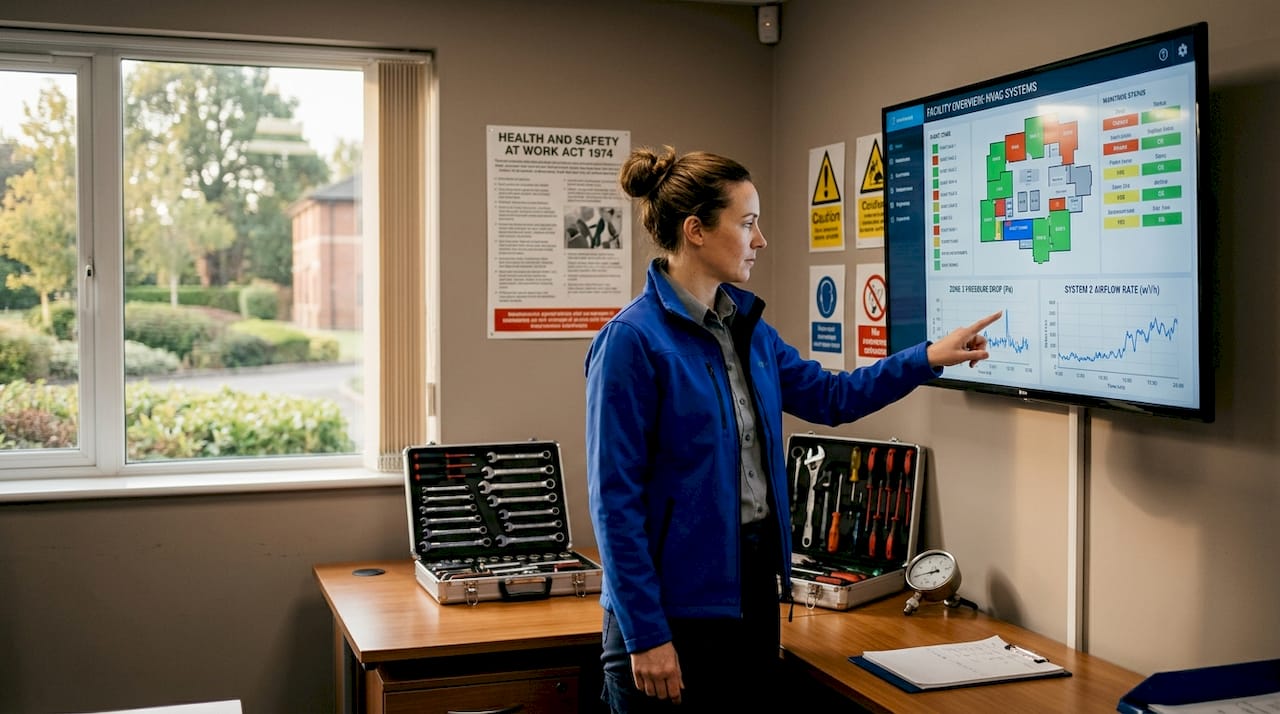
Condition-based maintenance, using pressure drop indicators rather than calendar schedules, delivers measurably better outcomes. When a filter’s pressure drop exceeds a set threshold, you know it needs changing. When it is still within range, changing it early wastes resource and introduces unnecessary disturbance to the system.
Here is how the two approaches compare in practice:
| Maintenance approach | Typical filter waste | Risk of missed failures | Cost impact |
|---|---|---|---|
| Calendar-based (quarterly) | Up to 30% filters changed prematurely | High (misses load-based degradation) | Higher long-term cost |
| Condition-based (pressure drop) | Near zero premature changes | Low (responds to actual condition) | Lower long-term cost |
Implementing condition-based maintenance does not require a major infrastructure investment. Here is a practical starting point:
- Install differential pressure gauges across all primary filter stages. These are low-cost and provide real-time visibility of filter loading.
- Set alert thresholds for each filter type and zone, based on manufacturer specifications and your specific airflow requirements.
- Move to digital logbooks to record pressure readings, maintenance actions, and fault history. This creates a data trail that supports compliance audits and helps identify recurring problems.
- Brief your maintenance team on what each reading means and what action it requires. The system only works if the people monitoring it understand what they are looking at.
- Link maintenance records to your planned maintenance programme, so condition-based triggers feed into scheduled service visits rather than generating unplanned callouts.
A structured approach to regular refrigeration maintenance alongside condition-based HVAC monitoring delivers significant compounding benefits over time. Facilities that adopt this approach typically report fewer emergency callouts, more consistent system performance, and reduced energy consumption.
Pro Tip: Pull together your last 12 months of maintenance logs before your next HVAC service contract renewal. Map out when filters were changed, what condition they were in, and what faults occurred. You will quickly see whether your current schedule is well-matched to your actual operational demands. This data also becomes your business case for investing in condition monitoring technology.
Integrating chiller maintenance into this condition-based approach makes sense, particularly in facilities where chillers and HVAC systems share monitoring infrastructure. Similarly, sites with catering operations benefit from applying the same principles to restaurant refrigeration maintenance to maintain food safety standards throughout the year.
Head-to-head: Comparing must-have HVAC features
With all the individual features covered, it helps to see them side by side. This comparison is designed to give you a quick-reference view of what each feature delivers and where it should sit in your investment priorities.
| HVAC feature | Primary benefit | Applicable sector | Priority level |
|---|---|---|---|
| Positive pressure differentials | Contamination prevention | Food manufacturing, high-care zones | Critical |
| Class A/B grease filtration | Fire safety, hygiene, compliance | Commercial kitchens | Critical |
| Zone-based climate control | Segregation, flexibility | Both sectors | High |
| Make-up air balancing | Air quality, energy efficiency | Commercial kitchens | High |
| Condition-based filter monitoring | Reduced cost, reliability | Both sectors | High |
| HEPA filtration | Airborne particle removal | Food manufacturing | High (high-care zones) |
| Canopy overhang design | Capture efficiency | Commercial kitchens | Moderate to high |
| Digital maintenance logbooks | Compliance, audit trail | Both sectors | Moderate |
Key decision points for facility managers:
- Prioritise contamination control above comfort features, particularly in food manufacturing environments.
- Do not compromise on filtration grading in kitchens. Undersized filters create downstream problems that cost significantly more to resolve.
- Zone control is an investment that pays back, particularly in multi-use facilities where temperature requirements differ across areas.
- Invest in cold room integration early, before systems are installed separately and retrofitting becomes complex and expensive.
- Build maintenance into the specification, not as an afterthought. Facilities with strong maintenance programmes consistently outperform those that treat HVAC as a fit-and-forget installation.
What most facilities miss about HVAC: The hidden ROI
Here is something worth saying plainly: most facilities underestimate the return on investment that good HVAC specification actually delivers. The conversation tends to focus on upfront cost. But the operational cost of a poorly specified system, through energy waste, reactive maintenance, compliance failures, and product loss, routinely exceeds the cost difference between a standard and a premium specification over a three-to-five year period.
Contamination control features are a good example. Positive pressure systems and high-grade filtration are sometimes viewed as over-engineering for all but the most sensitive production environments. In our experience, that view changes quickly after a site has dealt with a contamination-related product recall or a failed third-party audit.
The same logic applies to condition-based maintenance. The monitoring hardware is not expensive. The data it generates is genuinely valuable. Yet many facilities continue to change filters on a fixed schedule because “that’s how it’s always been done.” Calendar-based routines provide a sense of control. Condition-based approaches provide actual control.
The hidden ROI also shows up in energy consumption. Dirty filters, unbalanced air systems, and poorly maintained equipment all increase the energy load on your HVAC infrastructure. Investing in energy efficient systems from the outset, and maintaining them properly, delivers measurable savings on energy bills that accumulate year on year.
The facilities that get the most from their HVAC investment are those that treat the system as a strategic operational asset, not a utility to be managed at minimum cost. That shift in perspective is where the real gains are found.
Take the next step towards smarter HVAC solutions
If the features covered in this article have highlighted gaps in your current setup, or if you are planning a new installation and want to get the specification right from the start, EcoFrost HVAC can help.
Every project we take on is designed around your specific operation, your products, and your site. Whether you need industry-leading cold rooms for a food manufacturing facility, a commercial fridge installation that integrates with your existing infrastructure, or a full commercial air conditioning solution built to DW/172 standards, our F-Gas certified engineers bring the expertise and attention to detail your operation requires. Get in touch to discuss your requirements with a member of our team.
Frequently asked questions
What is DW/172 compliance and why does it matter?
DW/172 sets the standard for kitchen ventilation ductwork design and performance in the UK, covering extract rates, filtration, and hygiene requirements. Non-compliance can result in failed inspections, insurance issues, and unsafe working conditions.
How does positive pressure help prevent contamination?
Positive pressure differentials in high-care areas force clean air to flow outward through openings, which physically prevents contaminated air from entering. It is one of the most reliable passive controls available for food manufacturing environments.
Which grease filter class and efficiency should facilities use?
Class A or B grease filters with at least 95% efficiency are the recommended specification for commercial kitchens in the UK. The choice between Class A and B should reflect your cooking volume and the type of food being prepared.
Why is condition-based maintenance more effective than traditional scheduling?
Condition-based monitoring targets maintenance actions at the point of actual need rather than a fixed date, which avoids premature replacements and reduces the risk of missed failures. Over time, this approach lowers costs and improves system reliability.
Are standard HVAC features enough for food manufacturing facilities?
Standard HVAC systems are not designed to meet the contamination control, zone segregation, and hygiene access requirements of food manufacturing. Facilities in this sector require purpose-specified features including positive pressure management, high-grade filtration, and independently controlled zones.