
TL;DR:
- Neglected cooling systems risk costly breakdowns, regulatory penalties, and inefficiency if maintenance is ignored. UK law mandates leak checks by certified engineers and periodic energy assessments based on system size, requiring diligent record-keeping. Proper preparation, execution, and verification of maintenance work ensure ongoing compliance, operational continuity, and cost savings for UK facilities managing commercial refrigeration and HVAC systems.
A neglected cooling system does not simply underperform. It fails at the worst possible moment, triggers regulatory penalties, and costs far more to fix than it ever would have cost to maintain. For UK facilities managers and business owners running commercial refrigeration or HVAC systems, a clear cooling system maintenance process is not optional — it is the difference between operational continuity and expensive, disruptive breakdowns. This guide covers everything you need to know: legal obligations under UK F-Gas Regulations and EPBR, practical preparation steps, a step-by-step maintenance procedure, and how to verify compliance once the work is done.
Table of Contents
- Understanding legal requirements for cooling system maintenance
- Preparing for effective cooling system maintenance
- Executing the cooling system maintenance process step-by-step
- Verifying cooling system performance and compliance after maintenance
- Reframing cooling system maintenance: pragmatic insights from UK facilities management experience
- Choose EcoFrost HVAC for reliable commercial cooling maintenance and compliance support
- Frequently asked questions
Key Takeaways
| Point | Details |
|---|---|
| Understand legal requirements | UK F-Gas and EPBR regulations dictate specific maintenance and inspection frequencies for commercial cooling systems. |
| Prepare thoroughly | Gather system details and ensure qualified technicians are scheduled to avoid compliance gaps. |
| Follow detailed procedures | Regularly replace filters, clean coils, perform leak checks, and document all maintenance activities. |
| Verify compliance | Maintain and produce records, conduct TM44 inspections when required, and monitor system performance. |
| Keep expert perspective | Combine legal knowledge, digital record-keeping, and proactive communication to prevent costly penalties and failures. |
Understanding legal requirements for cooling system maintenance
Before any spanner is picked up, you need to understand what the law requires. The cooling system maintenance process for commercial operations in the UK is shaped primarily by two frameworks: the UK F-Gas Regulations and the Energy Performance of Buildings Regulations (EPBR).
Under the UK F-Gas Regulations, commercial systems with refrigerant charges ≥5 tonnes CO₂ equivalent require leak checks at legally specified frequencies, carried out by certified engineers. Only F-Gas certified technicians can legally handle refrigerants — this is not a technicality to overlook.
The leak check schedule is determined by the size of your refrigerant charge, measured in tonnes of CO₂ equivalent (CO₂e):
| Refrigerant charge (CO₂e) | Minimum leak check frequency |
|---|---|
| ≥5 tonnes | Annually |
| ≥50 tonnes | Every 6 months |
| ≥500 tonnes | Every 3 months (quarterly) |
Under EPBR in England and Wales, commercial systems over 12kW must have TM44 inspections every 5 years. This is a formal assessment of your air conditioning system’s energy efficiency, carried out by an accredited assessor. Many operators underestimate the reach of this rule: the 12kW threshold applies to the combined output of all units in a building, not individual ones. Five small units each rated at 3kW still trigger TM44 obligations.
Key legal obligations at a glance:
- Leak checks must be performed by F-Gas certified technicians, not general maintenance contractors
- All servicing, leak check results, refrigerant quantities, and technician details must be recorded
- Records must be retained for a minimum of 5 years
- TM44 inspection reports must be filed when applicable
- Combined AC output determines TM44 compliance, not individual unit ratings
Regular refrigeration maintenance structured around these requirements is what keeps businesses compliant and fully protected from enforcement action.
Preparing for effective cooling system maintenance
With a clear picture of the legal framework, the next step is getting organised before any maintenance work begins. Good preparation prevents compliance gaps and ensures engineers can work efficiently when they arrive on site.
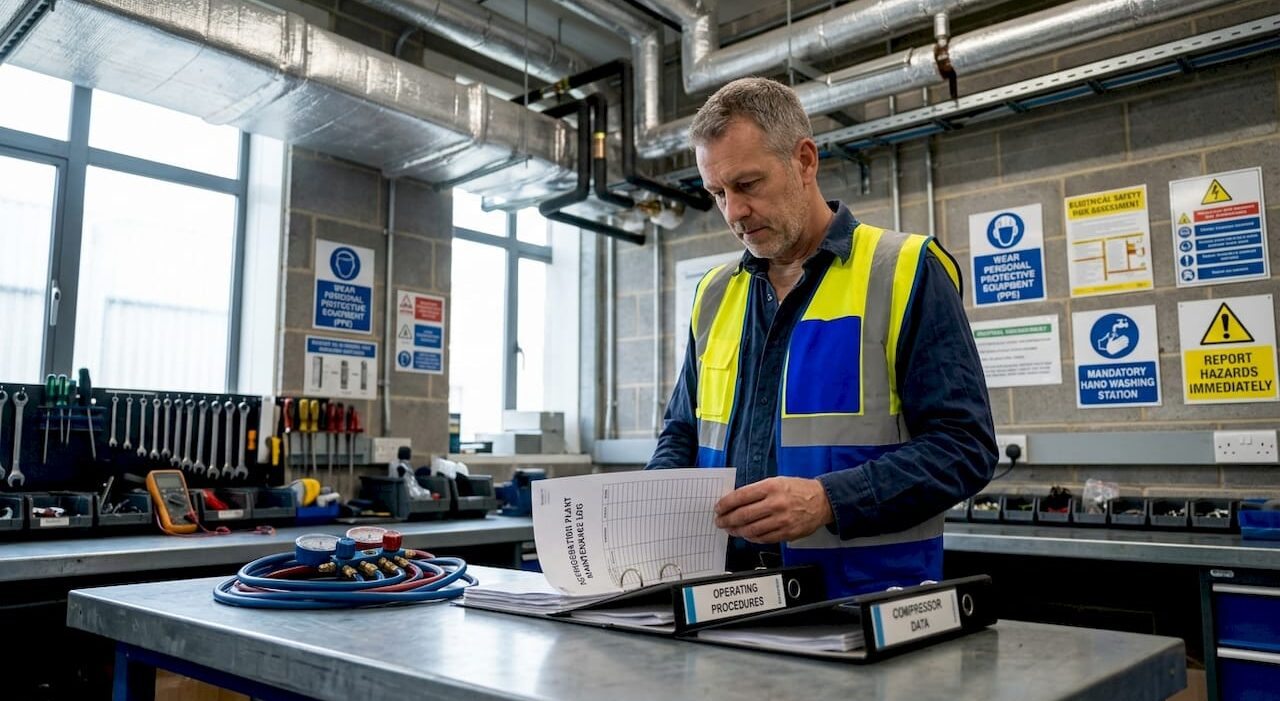
Start by gathering your system documentation. You will need:
- The make, model, and age of every cooling unit
- Refrigerant type and total charge weight for each system
- Previous maintenance logs, leak check certificates, and TM44 reports
- Engineer callout records and any known fault history
If your business is reviewing its refrigeration installation setup for the first time, establishing a clean documentation baseline at this stage will save considerable time later.
Next, check your scheduling. Do not wait until a legal deadline is approaching. Book certified F-Gas engineers well ahead of time, particularly for leak checks on larger systems where the frequency is every three to six months. Verify that every technician attending your site holds current F-Gas certification. Ask for their certification number before the visit, not after.
One area where operators frequently fall short is record-keeping. F-Gas records must be retained for at least 5 years, covering refrigerant type, quantities added or removed, leak check outcomes, and full technician details. A paper-based logbook carried in a drawer is not enough. An electronic logbook, accessible to your maintenance team and auditable at any point, is a far more reliable solution.
| Preparation task | Why it matters |
|---|---|
| Gather system documentation | Enables accurate leak check scheduling and legal compliance |
| Verify technician F-Gas certification | Ensures all refrigerant work is legally authorised |
| Establish electronic logbook | Prevents record-keeping gaps that attract penalties |
| Confirm TM44 status | Avoids overlooked obligations for multi-unit buildings |
| Schedule maintenance in advance | Prevents compliance lapses and last-minute callout fees |
Pro Tip: Set calendar reminders 8 weeks before each leak check deadline. This gives you enough time to book certified engineers, gather documentation, and address any access issues on site before the legal window closes.
Building consistent refrigeration maintenance habits at the preparation stage means you are never scrambling to catch up.
Executing the cooling system maintenance process step-by-step
With preparations complete, here is the practical execution of the cooling system maintenance process. Each step addresses a specific failure mode in commercial cooling systems.
-
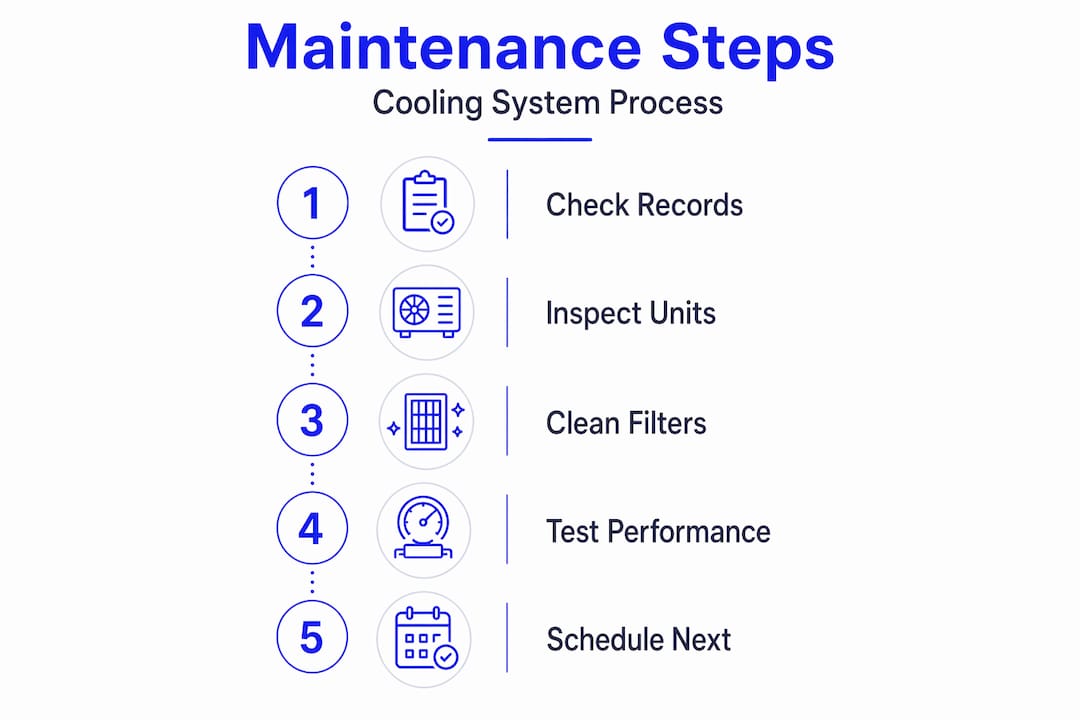
Replace or clean air filters. Replacing filters every 1-2 months during the cooling season improves efficiency and prevents premature system failure. In a commercial setting, blocked filters force the compressor to work harder, increasing energy consumption and accelerating wear.
-
Inspect and clean evaporator coils. Evaporator coils accumulate dirt even when filters are clean, reducing airflow and the system’s ability to absorb heat. Professional cleaning restores capacity and avoids the gradual efficiency loss that typically goes unnoticed until energy bills rise sharply.
-
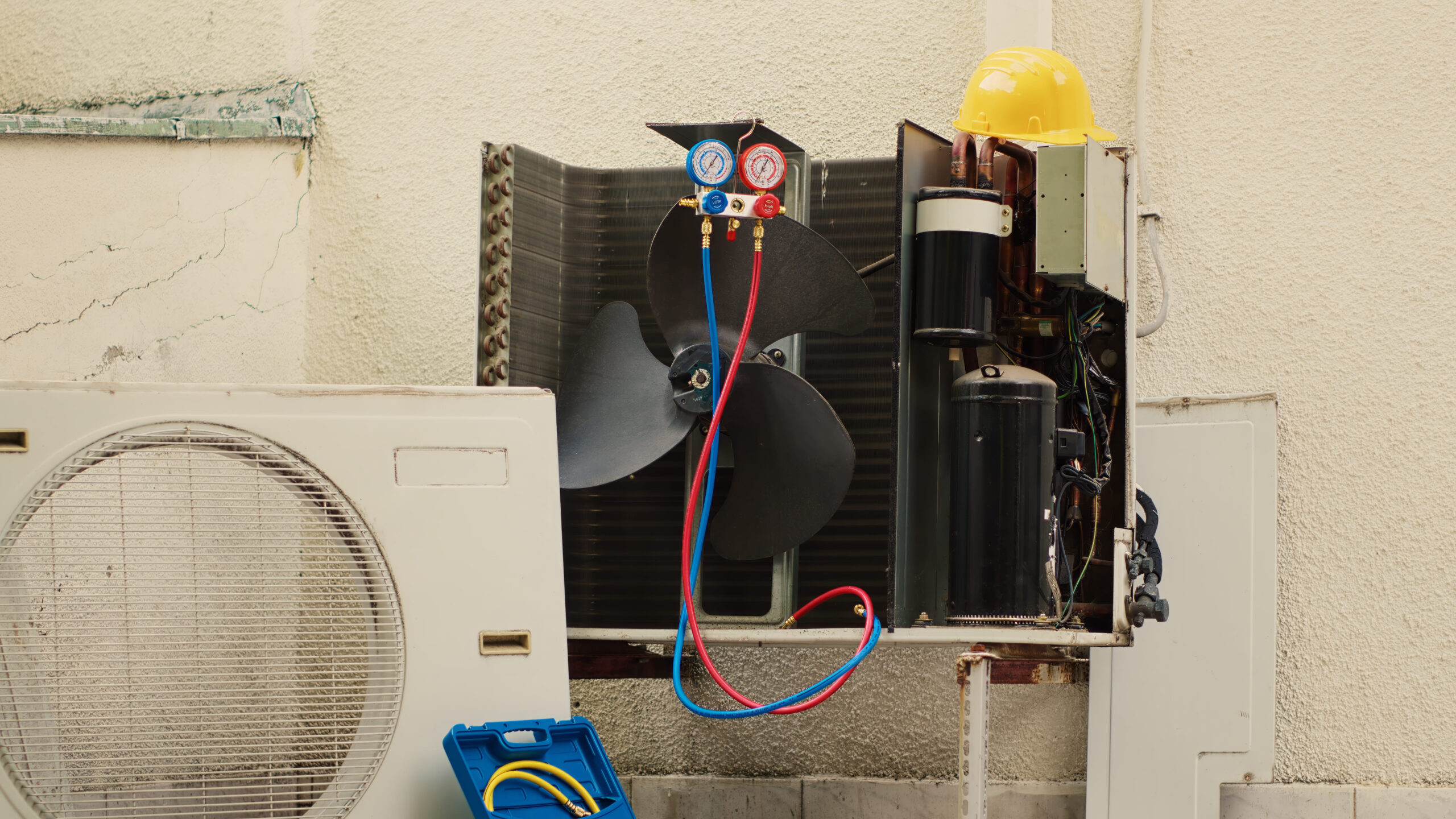
Clear outdoor condenser units. Check that condenser units are free from debris, vegetation, and blockages. A clearance of at least 60cm around the unit is the general standard. Airflow optimisation at this stage directly affects cooling capacity.
-
Straighten bent coil fins. Aluminium fins on evaporator and condenser coils bend easily and restrict airflow. A fin comb, available from refrigeration suppliers, can restore alignment. This is a minor task with a measurable impact on efficiency.
-
Perform refrigerant leak checks. These must be carried out at the legally required frequency by a certified F-Gas engineer using calibrated electronic leak detectors. If a leak is identified, it must be repaired before refrigerant is topped up — simply recharging a leaking system is illegal under UK F-Gas Regulations.
-
Update your logbook immediately. Record every action taken: filters replaced, coils cleaned, refrigerant quantities, leak check results, and technician details. Do this on the day of the visit, not retrospectively.
Refer to our cleaning guide for commercial refrigeration units for detailed guidance on coil and condenser cleaning procedures in food and retail environments.
| Maintenance task | Frequency | Consequence if skipped |
|---|---|---|
| Filter replacement | Every 1-2 months (cooling season) | Reduced airflow, compressor strain |
| Evaporator coil cleaning | Annually or as needed | Efficiency loss, potential system failure |
| Condenser clearance check | Quarterly | Overheating, compressor failure |
| Refrigerant leak check | Per F-Gas schedule | Legal penalty, refrigerant loss |
| Logbook update | After every visit | Compliance gap, risk of £20,000 fine |
Pro Tip: Ask your engineer to perform a system efficiency check — measuring supply air temperature and comparing it to manufacturer specifications — immediately after each service. This gives you a clear before-and-after performance benchmark and helps identify deterioration between visits.
When issues arise between scheduled visits, a refrigeration troubleshooting guide tailored to commercial systems can help your team identify whether a fault needs an immediate callout or can safely wait for the next scheduled visit.
Verifying cooling system performance and compliance after maintenance
Completing the physical maintenance work is only part of the process. Verification confirms that the work has achieved its intended outcome and that your business is properly protected on the compliance side.
Start with documentation:
- Confirm all leak check certificates and engineer reports have been received and filed
- Ensure records include refrigerant type, quantities, and technician certification numbers
- Lodge TM44 inspection reports with the relevant authority where applicable
- Set your next scheduled visit date and record it in the logbook
Operators must produce F-Gas compliance records on demand, and failure to comply risks civil penalties up to £20,000 per offence. Having documentation filed and accessible is not bureaucratic box-ticking — it is direct financial protection.
On the performance side, test the system after maintenance by checking:
- Supply air temperature against design specification
- Energy consumption readings compared to pre-maintenance baseline
- Any unusual noise, vibration, or cycling behaviour
If performance has not improved after a full service, this is a signal that a deeper fault, such as a failing compressor or blocked expansion valve, may be present. Acting on this early avoids a more costly cooling system repair further down the line.
Pro Tip: Share a brief maintenance summary with building tenants or operational stakeholders after each service. This keeps everyone informed about system status, demonstrates duty of care, and helps identify any reported performance issues that may not be visible during the engineer’s visit.
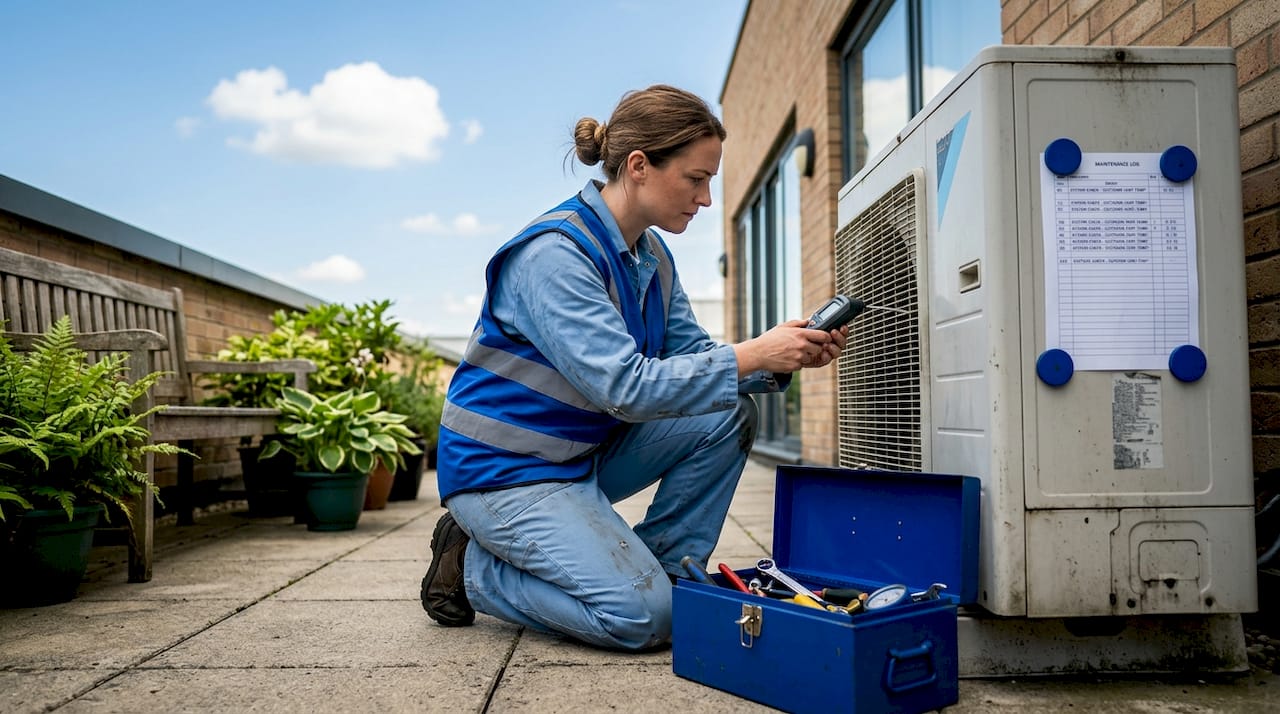
Schedule your next maintenance visit before the engineer leaves. Proactive scheduling consistently outperforms reactive callouts — both in cost and in operational continuity. Building this into your refrigeration maintenance compliance routine is one of the most effective ways to reduce downtime across a commercial estate.
Reframing cooling system maintenance: pragmatic insights from UK facilities management experience
Most guides focus on what to do. Fewer address where things actually go wrong in practice. After years of working with facilities managers across the UK, the recurring failures we see are rarely about physical maintenance. They are almost always about record-keeping and legal misunderstandings.
The most expensive mistake we see is this: a business carries out all its physical maintenance diligently but keeps poor records. An enforcement visit happens, records cannot be produced, and the operator faces penalties — despite the fact that the system was well maintained. F-Gas records must be retained for at least 5 years after decommissioning, which means documentation obligations outlast the equipment itself.
The second common pitfall is the TM44 threshold. Many facilities managers assume the 12kW rule applies per unit. It does not. The 12kW threshold applies to combined output across all units in the building. A site with six 3kW units has a combined output of 18kW and is fully subject to TM44 requirements. We have seen businesses receive enforcement notices for inspections they did not know they needed.
There is also a tendency to treat small refrigerant leaks as minor inconveniences. A slow leak left unattended will exceed its legal reporting threshold, accelerate refrigerant loss, and ultimately cause compressor failure. The repair bill for a failed compressor typically runs into thousands. The cost of catching the leak early is a fraction of that.
Viewing restaurant refrigeration or wider commercial cooling maintenance as an ongoing investment, rather than a reactive cost, changes how it gets prioritised. Systems that receive consistent attention reliably outlast those that do not, often by years.
Choose EcoFrost HVAC for reliable commercial cooling maintenance and compliance support
Understanding the cooling system maintenance process is the first step. Having the right partner to execute it is what protects your business day to day.
EcoFrost HVAC provides tailored maintenance plans for commercial refrigeration and HVAC systems across the UK. Our engineers are fully F-Gas certified, and we handle everything from scheduled leak checks and evaporator coil cleaning to TM44 inspection coordination and digital logbook management. Whether you manage a single commercial cold room or a multi-site cooling estate, we design a programme that fits your system and your compliance timeline. We also provide regular refrigeration maintenance services backed by emergency cover, so any fault that arises between planned visits is dealt with quickly. For businesses running commercial air conditioning, we carry out energy efficiency audits to help reduce overheads alongside keeping you compliant. Get in touch to discuss a maintenance plan built around your operation.
Frequently asked questions
What are the legal leak check requirements for UK commercial refrigeration systems?
UK F-Gas Regulations require leak checks at least annually for systems with refrigerant charges of 5 tonnes CO₂e or more, with checks every 6 months for 50 tonnes or more, and quarterly for 500 tonnes or more, all performed by certified technicians.
When is a TM44 inspection required for commercial air conditioning?
A TM44 inspection is required at least every 5 years when combined AC output exceeds 12kW in England and Wales under EPBR, regardless of how many individual units make up that total output.
How often should air filters be changed during cooling season?
Air filters should be replaced every 1-2 months during the cooling season to maintain system efficiency and prevent the compressor strain that leads to premature failure.
Who is responsible for maintaining F-Gas compliance records?
The equipment operator — typically the building owner or facilities manager — is legally responsible for ensuring records are kept and available, even though a contracted engineer performs the physical work. The legal duty rests with the operator, not the contractor.
What are the consequences of non-compliance with F-Gas regulations?
Civil penalties up to £20,000 per offence apply for non-compliance with UK F-Gas Regulations, in addition to the operational risks of undetected leaks and compressor damage from running an under-charged or contaminated system.