
TL;DR:
- Centralised hotel cooling involves producing chilled water in a central plant to serve multiple indoor units, improving efficiency and guest comfort. Smart controls and zoning are essential to maximize operational benefits and energy savings, especially when integrated with building management systems. Retrofit options enable UK hotels to upgrade existing systems cost-effectively, supporting sustainability and better guest experiences.
Most hotel managers assume cooling is straightforward: one unit per room, one thermostat per guest, done. That assumption is costing UK hotels thousands of pounds a year in wasted energy and preventable guest complaints. What is centralised hotel cooling, and why does it represent such a significant departure from traditional room-by-room air conditioning? The answer involves a dedicated central plant, chilled water circulated throughout the building, and smart controls that adjust every zone based on real occupancy data. This guide breaks it all down, practically and clearly.
Table of Contents
- What is centralised hotel cooling?
- How centralised controls enhance hotel cooling efficiency
- District cooling and network-style centralised hotel cooling
- Zoning strategies for guest comfort and energy savings
- Best practices for implementing centralised hotel cooling in the UK
- A nuanced view: why centralised cooling is not a silver bullet without smart control and zoning
- Explore centralised cooling solutions with EcoFrost HVAC
- Frequently asked questions
Key Takeaways
| Point | Details |
|---|---|
| Centralized cooling defined | Centralized hotel cooling uses a central chilled-water plant distributing cooled water to multiple areas for improved efficiency. |
| Smart control integration | Building Management Systems unify control and scheduling, enabling energy savings and enhanced guest comfort. |
| Importance of zoning | Zoning allows temperature and humidity adjustments per zone, matching occupancy and load differences precisely. |
| District cooling benefits | Networks of buildings can share chilled water with metered billing, reducing energy use by up to half. |
| Retrofit possibilities | Existing systems can be upgraded with smart overlays, avoiding costly equipment replacement. |
What is centralised hotel cooling?
Centralised hotel cooling means producing chilled water in a dedicated plant and distributing it to multiple indoor units throughout the property, rather than relying on standalone air conditioning units in each room. This is fundamentally different from the split-system or packaged AC units many hotels in the UK still operate. Instead of dozens of compressors running independently, a single central chiller handles the load for the entire building.
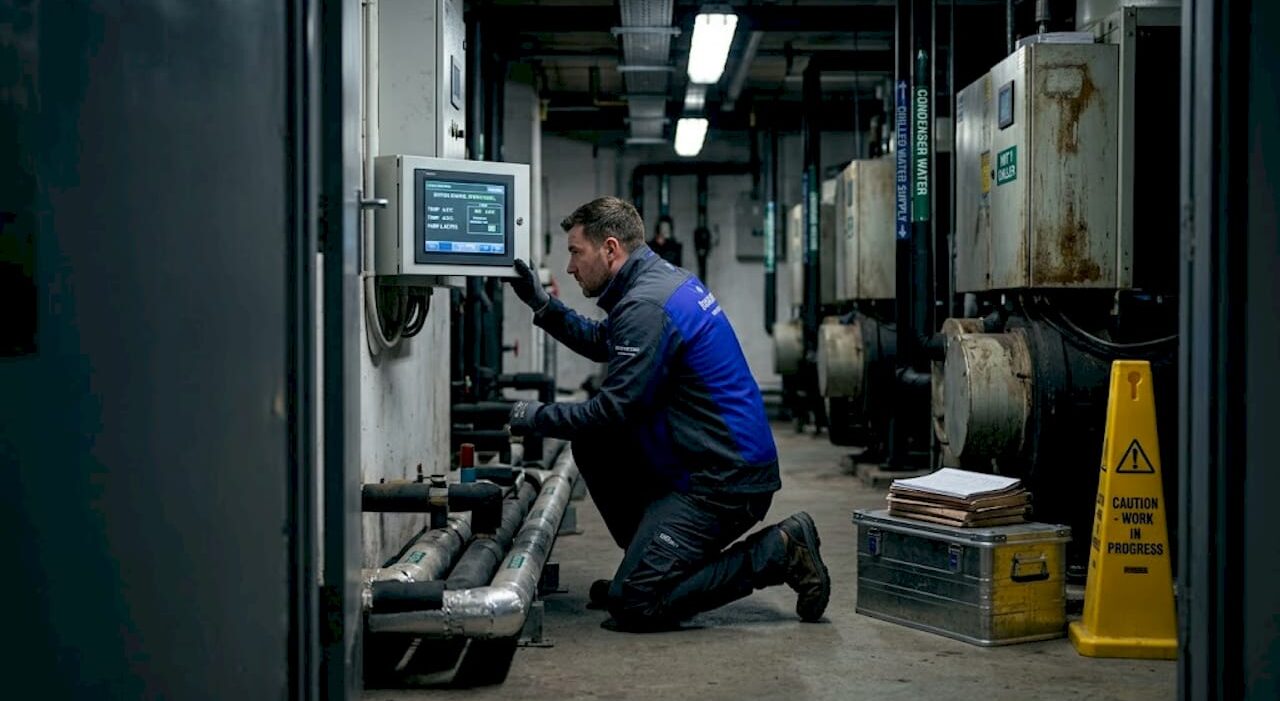
The architecture centres on a handful of key components working together. Understanding each one helps managers evaluate what they already have and what an upgrade would involve.
Key components of a centralised cooling system:
- Chiller unit: The central plant where heat is extracted from the water supply, producing chilled water typically at 6 to 12 degrees Celsius
- Cooling tower or condenser: Releases the extracted heat to the outside air or a water source
- Circulation pumps: Move chilled water through insulated pipework to every zone in the building
- Control valves: Regulate flow to individual zones based on demand signals from thermostats and sensors
- Terminal units: The in-room or in-zone equipment that uses the chilled water to cool air, typically fan coil units (FCUs) or air handling units (AHUs)
| Component | Function |
|---|---|
| Chiller | Produces chilled water from a central plant |
| Cooling tower | Rejects heat extracted from the building |
| Circulation pumps | Distribute chilled water through pipework |
| Control valves | Regulate water flow to individual zones |
| Fan coil units | Deliver cooled air within each room or area |
| Air handling units | Condition and distribute air across larger zones |
One central plant can serve an entire hotel building or, in larger properties, an entire campus. The insulated pipework that carries chilled water to each terminal unit is what makes the system genuinely efficient at scale. You can explore more about commercial chiller benefits to understand how this central plant differs from smaller refrigeration setups.
How centralised controls enhance hotel cooling efficiency
With the basic system explained, the next step is understanding what makes centralised cooling genuinely powerful rather than just centralised plant. The answer is smart controls, and specifically the Building Management System (BMS).
A BMS connects sensors, thermostats and HVAC equipment, creating a unified operational view that enables scheduling, zoning, fault detection, and energy reporting across the whole property. Without that layer, you have efficient central plant running inefficiently because nothing is coordinating demand.
What a BMS enables in a hotel environment:
- Scheduling: Cooling ramps up ahead of breakfast service or conference room bookings, not reactively after guests are already uncomfortable
- Zoning: Guest rooms, lobbies, kitchens, and function spaces each have their own control logic based on their distinct thermal loads
- Fault detection: The BMS flags underperforming zones or equipment issues before they become guest-facing problems
- Energy reporting: Managers can see exactly which zones are consuming what, enabling informed decisions about operational adjustments
- Occupancy integration: When linked to the property management system (PMS), the BMS can trigger setback modes for unoccupied rooms automatically
The HVAC features that matter most in hospitality settings are the ones that respond to actual conditions, not fixed schedules. A kitchen running a lunchtime service generates far more heat than a guest room with a sleeping occupant. Treating them with the same control logic wastes energy and fails guests.
Pro Tip: Without proper zonation, centralising plant alone misses most of the operational benefits. The central chiller may run efficiently, but rooms will either overcool or undercool because the terminal units are not receiving differentiated signals.
District cooling and network-style centralised hotel cooling
Beyond individual hotels, there is a model worth understanding for larger groups and campuses. District cooling distributes chilled water via insulated underground pipes to multiple buildings, metering consumption like a utility service. Think of it as shared air conditioning infrastructure, similar to how a district supplies gas or electricity.
For hotel groups operating several buildings on a shared site, or urban hotel clusters, this approach offers scale efficiencies that a building-by-building approach simply cannot match.
Why district cooling is worth considering:
- Energy savings of 30 to 50% compared to standalone AC systems are achievable due to load diversity and central plant efficiency
- Individual buildings receive metered chilled water and pay by consumption, giving clear accountability for energy use
- A single, well-maintained central plant is more reliable than dozens of individual units with varied service histories
- Large hotel campuses, convention centres, and mixed-use developments benefit most from this model
- The approach aligns well with UK sustainability targets, as centralised generation allows easier integration of low-carbon technologies
You can explore cost-efficient refrigeration solutions that share similar principles of centralised generation and distributed delivery.
The regulatory direction in the UK, particularly around carbon reduction commitments, also favours district and centralised cooling over individual refrigerant-heavy systems scattered across multiple rooftops.
Zoning strategies for guest comfort and energy savings
Understanding district networks helps frame the big picture. Inside the hotel itself, zoning is where centralised cooling translates into genuine guest comfort rather than just lower energy bills.
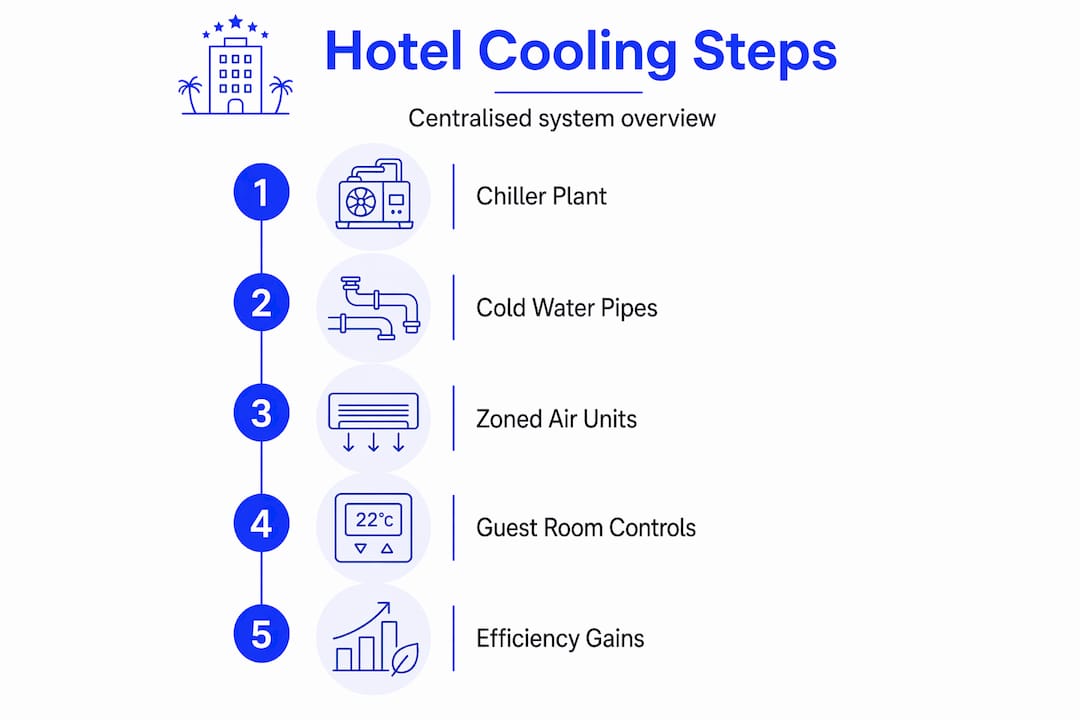
Zoning provides distinct thermostat and control logic per area, responding to unique loads and occupancy rather than applying a single static setpoint across the building. A lobby at 3pm in July and a guest room at 3am require completely different cooling responses. Zoning ensures each gets exactly what it needs.
How an effective hotel zoning process works:
- Map the zones by usage type: guest rooms, corridors, reception, restaurant, conference rooms, back-of-house, and kitchen
- Install sensors appropriate to each zone: occupancy sensors in guest rooms, CO2 sensors in conference areas, temperature and humidity sensors throughout
- Set control logic per zone, including occupied setpoints, setback temperatures for unoccupied periods, and pre-conditioning windows before expected occupancy
- Integrate with the PMS so room bookings automatically trigger pre-conditioning before guest arrival
- Monitor and refine using BMS energy reports to identify zones that are overcooling or not meeting setpoints consistently
An effective hotel cooling approach accounts for occupancy patterns across every area, not just guest rooms. Conference facilities with 200 people generate an enormous cooling load; the same room the following morning with a single meeting needs a fraction of that capacity.
Pro Tip: Proper humidity control within zones reduces guest complaints significantly. UK hotels often focus purely on temperature, but high humidity in guest rooms is a common source of discomfort that temperature control alone does not resolve.
Best practices for implementing centralised hotel cooling in the UK
Having explored operational benefits, the practical question for most UK hotel managers is: where do we start? The answer depends heavily on your existing infrastructure.
Steps to approach implementation effectively:
- Audit your current setup: Understand what BMS or building automation system (BAS) you already have. Many hotels have legacy controls that can be extended rather than replaced
- Integrate, do not wholesale replace: Successful retrofits integrate new smart controls with existing BAS via supported protocols, optimising scheduling and fault detection without touching the core control architecture
- Prioritise occupancy sensing: Even basic passive infrared sensors in guest rooms give the BMS the data it needs to run meaningful setback programmes
- Link to your PMS: If your property management system can communicate room booking data to the BMS, you unlock pre-conditioning and arrival scheduling without any manual input
- Plan central plant maintenance: A central chiller working harder than multiple small units needs a structured maintenance programme. Reliability depends on it
- Zone carefully from the outset: Poorly designed zones cause problems that are expensive and disruptive to correct after installation
The energy efficient cooling advantages of a well-implemented centralised system are only realised when controls and zoning are designed alongside the plant, not as an afterthought.
Pro Tip: A hybrid approach works well for phased transitions. Keep in-room thermostats so guests feel in control, but overlay central scheduling so the BMS governs setback and pre-conditioning without guest interaction. It avoids the friction of removing familiar controls while still delivering operational efficiency.
A nuanced view: why centralised cooling is not a silver bullet without smart control and zoning
There is a common misconception that upgrading to centralised cooling plant is the main event, and controls and zoning are optional extras. In practice, the opposite is closer to the truth.
Centralised does not equal centralised comfort unless the terminal units are properly zoned and controlled to meet occupancy and load variations. A central chiller running at high efficiency while terminal units in unoccupied rooms cool empty space is not a success story. It is just waste at a larger scale.
What we see, working with UK hotels and hospitality operators, is that managers often invest in the central plant and then underinvest in the control layer. The chiller gets specified correctly, installed professionally, and commissioned to a high standard. Then the BMS either does not get updated to support the new zones, or the zoning itself is too coarse to make a real difference. A 200-room hotel with five zones is not genuinely zoned. It is loosely grouped.
The hotel chiller systems insight that experienced engineers bring to a project is knowing that the mechanical and the digital sides of the system must be designed together. Retrofitting smart overlays onto a poorly zoned mechanical system produces modest gains. Retrofitting controls onto a well-zoned mechanical system can transform energy performance with relatively low capital investment.
Managers should also be realistic about humidity. Guest comfort involves temperature and humidity working together. A room cooled to 21 degrees Celsius with 70% relative humidity will generate complaints. The same room at 22 degrees with 50% humidity will feel comfortable. Centralised chilled-water systems are well placed to handle dehumidification as part of their operation, but only if the terminal units and controls are set up to prioritise it.
The practical takeaway is this: ask any supplier or engineer you work with to specify not just the plant, but the zoning architecture and control logic alongside it. If they cannot do that, the project is incomplete before it starts.
Explore centralised cooling solutions with EcoFrost HVAC
If you are a UK hotel or restaurant manager considering centralised cooling, the right installation partner makes a significant difference to both outcomes and running costs.
At EcoFrost HVAC, we design and install commercial air conditioning systems tailored to the specific demands of hotels, restaurants, and hospitality venues across the UK. Our engineers are F-Gas certified and experienced in centralised chilled-water systems, BMS integration, and zoning design. We do not apply generic specifications. Every project is assessed on your building layout, occupancy patterns, and operational requirements. From initial assessment through to ongoing maintenance and emergency cover, we are with you for the life of the system. Explore our cost-efficient refrigeration solutions and energy efficient cooling advantages to understand what a properly designed system can deliver for your property.
Frequently asked questions
What does centralised hotel cooling mean?
It refers to a system where chilled water is produced centrally in a dedicated plant and then circulated to multiple indoor terminal units across the hotel, rather than using separate air conditioners in each room.
How does zoning improve guest comfort in centralised cooling?
Zoning with per-zone thermostats divides the hotel into areas with unique control logic, allowing temperature and humidity to adjust based on actual occupancy and the specific thermal demands of each space.
Can centralised cooling systems connect to building management systems?
Yes, centralised cooling typically integrates with a BMS that coordinates scheduling, fault detection, and energy reporting. A smart building management system connects guest rooms, common areas, and back-of-house zones into a single operational view.
What are the benefits of district cooling for hotels?
District cooling reduces energy consumption by 30 to 50% compared to standalone systems, and delivers chilled water from a central plant to multiple buildings with metered billing similar to a utility service.
Is it possible to retrofit existing hotel cooling systems to be centralised?
Yes. Successful retrofits integrate additional smart controls via supported protocols to extend existing BAS capabilities, enabling centralised scheduling and optimisation without the disruption of replacing core equipment.