

TL;DR:
- UK hotel refrigeration compliance depends on proper documentation of temperature logs and engineer records, not just equipment function. Both food safety and F-Gas regulations require consistent monitoring, corrective actions, and certified engineer involvement to pass inspections. Strong record-keeping and routine maintenance are crucial to avoid fines, ensure food safety, and minimize environmental impact.
Refrigeration compliance in UK hotels is one of those areas where even diligent operators get caught out, not because their fridges are failing, but because their paperwork is. Many hotel managers assume that as long as temperatures are cold, the job is done. In reality, an inspector walking through your kitchen is looking at your logs, your corrective action records, and your engineer reports just as closely as they are checking the display reading. Getting this wrong can mean fines, closures, or worse, a food safety incident that damages your reputation with guests.
Table of Contents
- Understanding compliance requirements in hotel refrigeration
- Best practices for temperature control and food safety
- Environmental compliance: The F-Gas regulations and energy impact
- Maintaining documentation and audit trails: Avoiding the costly pitfalls
- What most hotels get wrong about refrigeration compliance
- Strengthen your hotel’s compliance and efficiency
- Frequently asked questions
Key Takeaways
| Point | Details |
|---|---|
| Documentation is critical | Missing records—not faulty fridges—lead to most compliance penalties for UK hotels. |
| Follow food safety protocol | Strict monitoring, temperature logging, and corrective actions are essential for safe food storage. |
| Maintain environmental standards | F-Gas compliance and low-GWP refrigerants cut both emissions and long-term costs. |
| Proactive maintenance pays | Routine checks and cleaning improve efficiency, prevent breakdowns, and ensure compliance. |
Understanding compliance requirements in hotel refrigeration
Now that the primary challenge is clear, let us break down the specific rules you must follow and why compliance means more than cold storage.
Hotel refrigeration sits at the intersection of two distinct regulatory frameworks in the UK. The first is food safety legislation, governed by HACCP principles (Hazard Analysis and Critical Control Points). The second is the F-Gas Regulations, which control how refrigerants are managed to protect the environment. Both carry real consequences if ignored, and both demand more than just functioning equipment.
Refrigeration compliance explained involves understanding that these two frameworks overlap significantly in day-to-day operations. A hotel kitchen that nails food safety but neglects F-Gas paperwork is still non-compliant. The same applies in reverse.
UK food safety regulations require chilled food storage at 8°C or below, with best practice sitting at 5°C or below, along with twice-daily temperature logging, probe checks on food, and corrective actions documented under HACCP principles. That is a specific, measurable obligation that your team must meet every single day.
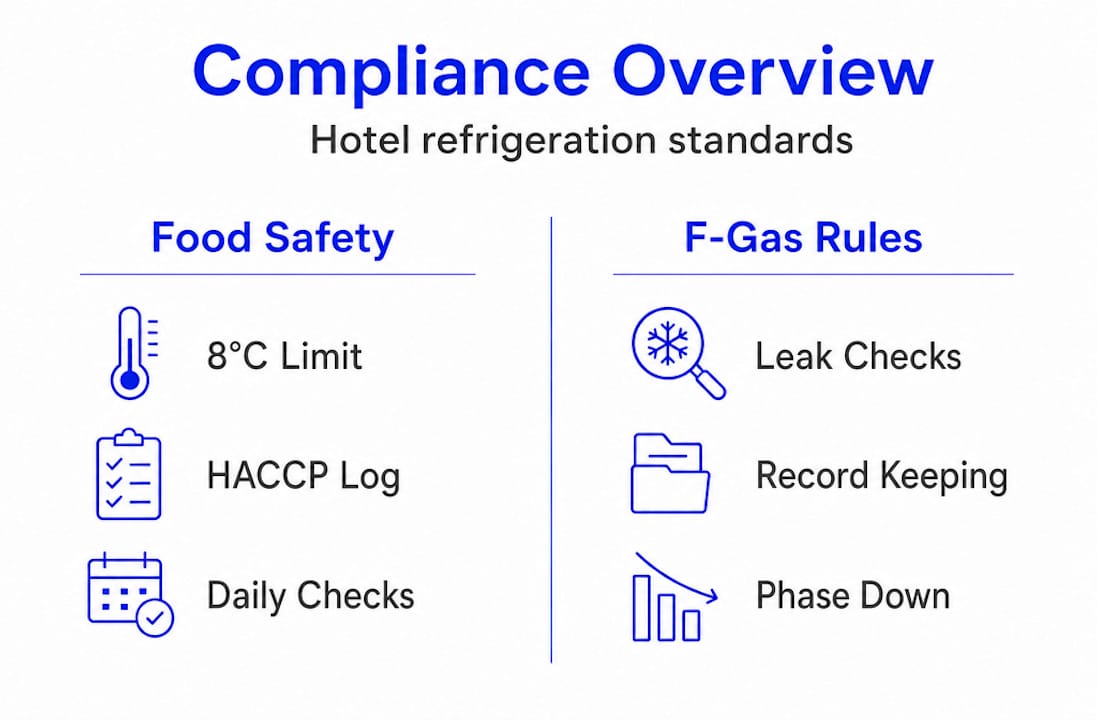
Here is a clear comparison of what each framework focuses on:
| Area | HACCP (food safety) | F-Gas regulations |
|---|---|---|
| Primary focus | Safe food temperatures and storage | Refrigerant emissions and environmental impact |
| Who is responsible | Kitchen and operations managers | Maintenance and engineering teams |
| Key requirement | Temperature logs, corrective actions | Leak detection, engineer records, refrigerant logs |
| Inspection evidence | Daily logs, HACCP records | Service certificates, F-Gas engineer reports |
| Consequence of failure | Food safety enforcement, closure | Financial penalties, supply restrictions |
Understanding the distinction helps you assign responsibility correctly across your team. It also makes it clear why you need hotel refrigeration terms to be familiar to everyone involved in maintenance and kitchen operations, not just your head chef.
Key compliance requirements across both frameworks include:
- Daily and twice-daily temperature monitoring with written or digital records
- Documented corrective actions whenever a breach occurs
- F-Gas certified engineers carrying out all refrigerant work
- Leak checks on systems with refrigerant charges above legal thresholds
- Annual servicing records kept on file and accessible during inspections
Inspectors do not just check whether your fridge is cold. They check whether you can prove it was cold at the right times, on the right days, with the right responses when it was not.
The different hotel refrigeration types you operate, from walk-in cold rooms to bottle coolers, all fall under these requirements. There is no exemption for smaller units in a hospitality environment.
Best practices for temperature control and food safety
With the regulations and standards outlined, let us get practical on how you can consistently hit and prove compliance every day.
HACCP is not just a document you create once. It is a living process that your team follows every shift. In a hotel kitchen context, this means identifying refrigeration as a Critical Control Point (CCP). A CCP is any step in your food handling process where a failure could result in harm to a guest. Refrigeration is almost always one of these steps.
HACCP identifies refrigeration as a Critical Control Point, requiring monitoring procedures, critical limits such as 8°C, and corrective actions like discarding food held above 8°C for more than four hours, or above 2°C in what is known as the danger zone for extended periods.
Here is a practical overview of the checks your team should carry out:
| Check type | Frequency | Who is responsible | Action if failed |
|---|---|---|---|
| Fridge air temperature | Twice daily minimum | Kitchen staff | Log, investigate, escalate |
| Food probe temperature | On delivery and spot checks | Sous chef or manager | Reject delivery or discard food |
| Corrective action record | Whenever a breach occurs | Shift manager | Complete form, retain with daily log |
| Equipment condition check | Weekly | Kitchen manager | Report faults, arrange engineer visit |
| Engineer service record | Annually minimum | Maintenance manager | Retain certificate for inspections |
When a temperature breach does occur, your team needs to respond in a structured way. Here is the correct process:
- Record the breach immediately in your temperature log, noting the time, the reading, and which unit is affected.
- Remove all food from the affected unit and assess whether it has been held above the critical limit for more than four hours.
- Discard any food that cannot be confirmed as safe, and document what was discarded and why.
- Investigate the cause. Is it a door seal failure, a compressor issue, or a power fault? Log your findings.
- Call your refrigeration engineer if the fault cannot be resolved by staff. Keep the engineer’s visit record on file.
- Do not return the unit to service until it is confirmed to be holding temperature at the correct level.
Pro Tip: Inspectors are far more impressed by a clean record that shows a breach was caught and corrected properly than by a log with no issues at all. Consistent, honest logging demonstrates genuine food safety management. Gaps or suspiciously perfect records raise concern.
Regular maintenance for compliance is what keeps your units reliable enough to maintain food safety standards day after day, reducing the frequency of those corrective action events in the first place.
Environmental compliance: The F-Gas regulations and energy impact
After covering food safety, it is critical to address the environmental responsibilities every UK hotel faces with refrigeration systems.
The F-Gas Regulations (formally the Fluorinated Greenhouse Gases Regulations) apply to any refrigeration system using hydrofluorocarbon (HFC) refrigerants. These refrigerants have a high Global Warming Potential (GWP), meaning even small leaks can have a significant environmental impact. In UK hotels, this covers the majority of commercial refrigeration units currently in operation.
Key obligations under F-Gas for hotel operators include:
- Having all refrigerant work carried out by F-Gas certified engineers only
- Completing mandatory leak checks based on the refrigerant charge (systems containing 5 tonnes CO2 equivalent or more require checks at least annually)
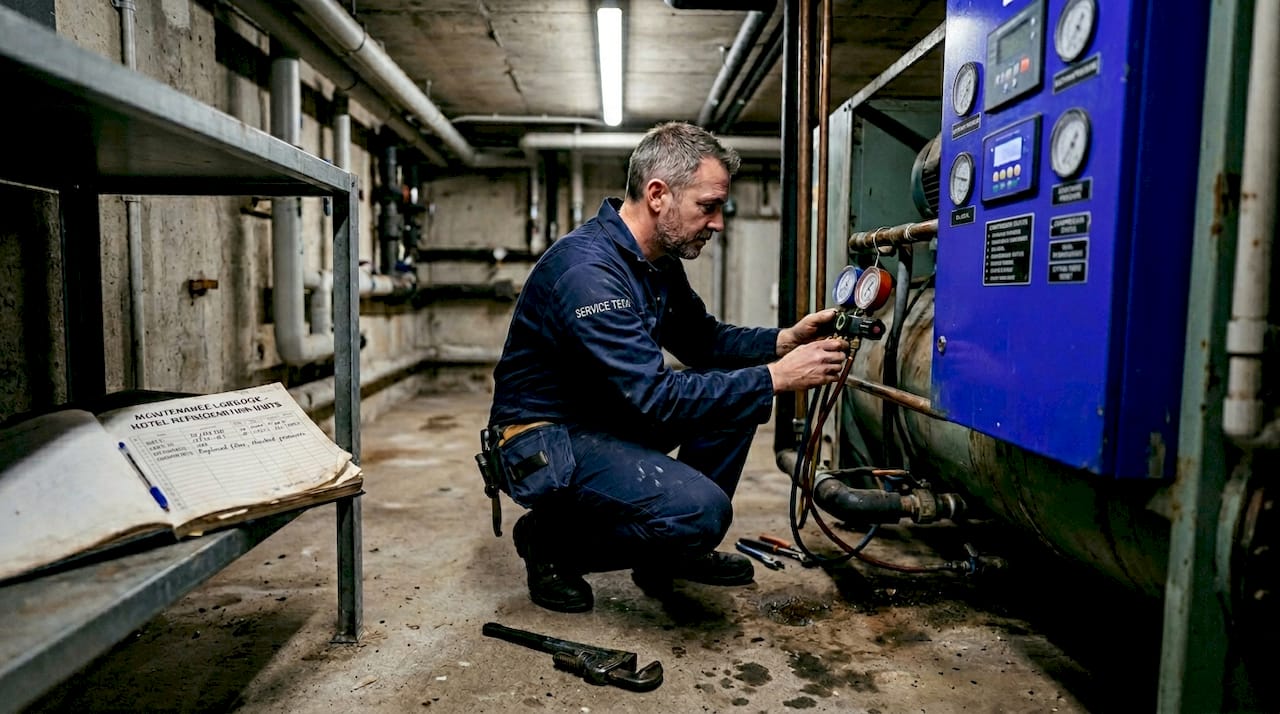
- Maintaining a system logbook recording refrigerant type, charge weight, additions, removals, and any leak findings
- Transitioning away from high-GWP refrigerants as the phase-down continues
The F-Gas rethink on refrigerant strategy is clear: documentation outweighs performance, and missing records trigger fines even without leaks. That single point is one of the most important things a hotel facilities manager can take away. A system running perfectly, but with no certified engineer records, is a system that will fail an inspection.
The industry is also in the middle of a structured phase-down of high-GWP refrigerants. This means the supply of some older refrigerant types is already becoming restricted and increasingly expensive. Hotels that delay retrofitting to low-GWP alternatives are gambling on supply availability and cost stability.
Pro Tip: If your cold rooms or large refrigeration units still use older refrigerants like R404A or R22, speak to an F-Gas certified engineer now about your options for low-GWP retrofitting. The cost of a planned transition is consistently lower than an emergency regas when supply runs short.
The importance of refrigeration safety extends beyond food. Leaking refrigerants are a hazard in enclosed spaces and an environmental liability for your business. Compliance here is not just about avoiding fines. It protects your staff, your guests, and your operating licence.
Energy and HVAC maintenance data consistently shows that well-maintained, compliant refrigeration systems run significantly more efficiently. Reduced refrigerant leakage, clean condenser coils, and correctly charged systems translate directly into lower energy consumption, which matters for both operational costs and sustainability reporting.
Maintaining documentation and audit trails: Avoiding the costly pitfalls
Clear environmental benefits are only part of the picture. Without the right records, your efforts could all be for nothing.
The compliance principle that surprises most hotel operators is this: documentation is not a byproduct of good maintenance. It is the evidence that good maintenance happened. An inspector cannot see whether your fridge ran at 4°C last Tuesday unless you can show them a log that says so.
A perfectly functioning refrigeration system with no paperwork trail is, from a compliance perspective, the same as a broken one.
Essential records every UK hotel must maintain include:
- Daily temperature logs for all refrigeration units, signed by the responsible person
- Corrective action reports whenever any breach or fault is identified
- Engineer service reports and maintenance visit certificates
- F-Gas system logbooks including refrigerant type, quantity, and certified engineer details
- Delivery inspection records where temperature-sensitive goods are received
- Cleaning records for refrigeration units and cold room interiors
Common pitfalls that result in fines and enforcement notices include:
- Gaps in daily temperature logs, even if the unit was functioning correctly
- Corrective action records that are vague, unsigned, or missing entirely
- F-Gas logbooks that have not been updated after engineer visits
- No record of refrigerant additions or leak test results
- Using uncertified engineers for refrigerant work and having no documentation to prove otherwise
Scale buildup cuts chiller efficiency by 20 to 25%, which is a measurable financial impact that also shows up as increased energy bills before any visible fault appears. Regular cleaning of commercial refrigeration units is therefore not just a hygiene issue. It is a maintenance record item that keeps systems efficient and gives you another documented action to present during an audit.
A practical approach to equipment safety checklists can help hotel teams build consistent habits across shifts. The goal is to make logging so routine that it happens automatically, rather than being something staff remember to do only when prompted by management or an upcoming inspection.
What most hotels get wrong about refrigeration compliance
With a full toolkit of compliance strategies, let us pause and examine a crucial misconception that catches hoteliers out time and again.
Most hotels do not fail refrigeration inspections because their equipment is faulty. They fail because of gaps in their records. We see this pattern repeatedly: a well-run kitchen with reliable units and attentive staff that still receives an enforcement notice because the corrective action form for a temperature event was never completed, or because the F-Gas logbook has not been updated in eighteen months.
The misconception is that compliance is primarily a technical challenge. In reality, it is primarily a management and discipline challenge. Your fridges are not the problem. Your systems for recording what your fridges do are the problem.
There is also a common belief that if an inspector visits and the fridge is cold right now, that is enough. It is not. Inspectors are trained to look back over weeks and months of records. They want to see consistency, correction, and accountability, not just a satisfactory reading on the day.
The practical wisdom here is to invest effort in building habits rather than chasing perfect readings. A fridge that occasionally runs at 6°C but has consistent logs showing it was caught, corrected, and investigated is a far better compliance picture than a fridge that runs at 3°C but has a log book full of blank lines.
Saving on compliance costs comes from getting this right proactively, not from reacting to enforcement. Hotels that build compliance into daily operations, with clear responsibility assigned to named individuals, find that audits become straightforward rather than stressful.
The other area where hotels consistently underestimate the risk is the F-Gas side. Kitchen managers often assume F-Gas is “the engineer’s problem.” But the legal obligation sits with the operator. If your certified engineer has not updated the system logbook after a service visit, that is your responsibility to chase and resolve, not to ignore.
Strengthen your hotel’s compliance and efficiency
If the steps outlined above have highlighted gaps in your current approach, the right time to address them is now, before the next inspection.
EcoFrost HVAC works with hotel operators across the UK to design, install, and maintain refrigeration systems that are built around compliance from day one. Our F-Gas certified engineers carry out every installation and service visit to the standard that inspectors expect to see, and we provide the documentation your team needs to maintain a clean audit trail. Whether you need a cold room installation tailored to your kitchen layout or guidance on your full range of hotel refrigeration solutions, we bring the same level of care and expertise to every project. Get in touch with our team to discuss what your hotel needs.
Frequently asked questions
What are the legal fridge temperature limits for UK hotels?
UK law requires chilled food to be stored at 8°C or below, with best practice at 5°C or lower for hotel kitchens handling high volumes of perishable produce.
How often should hotel staff log fridge temperatures?
Twice-daily temperature logging is the minimum recommended frequency under UK food safety and HACCP requirements, though higher-risk environments may benefit from more frequent checks.
What happens if food exceeds the safe temperature in hotel refrigeration?
Food held above 8°C for more than four hours must be discarded, with the corrective action fully documented including the time, temperature, quantity discarded, and cause investigated.
Why can hotels be fined even if their refrigeration works perfectly?
Missing records trigger fines even without leaks or equipment failures, because documentation is itself a legal compliance requirement under both F-Gas and food safety frameworks.
Does refrigeration maintenance affect hotel energy bills?
Yes. Scale buildup reduces chiller efficiency by 20 to 25%, which directly increases energy consumption and operating costs over time, making regular maintenance a financially sound investment.
Recommended
- What is refrigeration compliance and why it matters in 2026
- Refrigerants in HVAC: Energy savings and compliance 2026 – Ecofrost hvac Ltd
- Regular refrigeration maintenance: save costs, boost compliance
- Hotel refrigeration types explained for optimal efficiency
- Liebherr Rsfd 4600 Pure Ψυγείο Συντήρησης Υ145.5xΠ59.7xΒ67.5εκ. Inox | euragora.gr
- Industrial equipment safety checklist: Essential steps for compliance – CONQUEST MFG USA