
TL;DR:
- Properly specified and monitored cold rooms are essential for energy efficiency, regulatory compliance, and stock preservation in UK food and manufacturing sectors. Modern cold room systems rely on advanced controls, sensors, and smart features that significantly reduce operational costs and improve reliability. Regular maintenance, staff training, and future-proof planning maximize the return on investment for these engineered environments.
The assumption that all commercial refrigeration is broadly similar costs UK food and manufacturing businesses real money every year. A poorly specified cold room, running on outdated controls without proper monitoring, can silently inflate energy bills, create compliance risks, and shorten the lifespan of stock. Understanding how modern cold room technology actually works, and what separates a well-engineered system from a basic one, is one of the most practical steps any operations manager or business owner can take before committing to an installation or upgrade.
Table of Contents
- What is cold room technology?
- How does cold room refrigeration work?
- Smart controls and energy optimisation in modern cold rooms
- Selecting the right cold room for your business needs
- The missing link: Why most businesses underuse cold room technology
- Next steps: Reliable cold room solutions for your business
- Frequently asked questions
Key Takeaways
| Point | Details |
|---|---|
| Precision cooling matters | Cold room technology is engineered for accurate, large-scale temperature control beyond standard fridges. |
| Smart controls save energy | Modern cold rooms with advanced monitoring can reduce running costs by over 20%. |
| Tailored solutions boost value | Choosing the right cold room setup for your needs is vital for long-term savings, compliance, and food safety. |
| Upgrades offer measurable ROI | Investing in technology and maintenance can quickly pay for itself through improved reliability and efficiency. |
What is cold room technology?
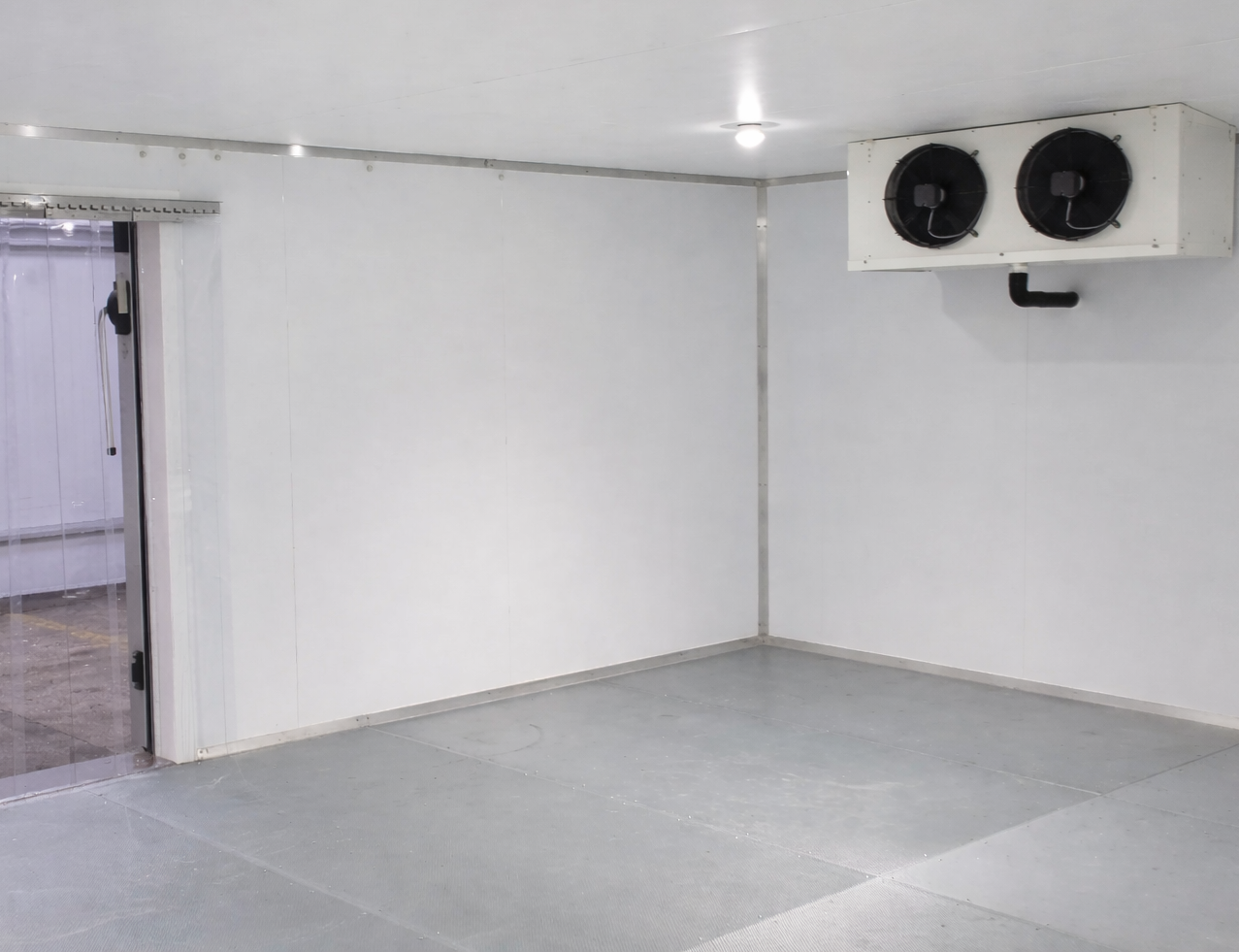
Cold rooms are purpose-built, controlled environments designed to maintain products at precise low temperatures over extended periods. Unlike a standard commercial fridge, a cold room is a structural installation. It is built into or within your facility, with insulated panels forming the walls, floor, and ceiling, combined with a dedicated refrigeration unit and a control system that manages temperature continuously.
In the UK food service and manufacturing sectors, cold rooms serve an enormous range of functions. A busy restaurant kitchen relies on a chiller room to keep prepared ingredients and perishables at safe temperatures throughout service. A food manufacturer may operate multiple cold zones simultaneously, each maintaining different temperature ranges for raw materials, processed goods, and packaging.
The core components of any cold room installation include:
- Insulated structure: High-performance panels (typically 80mm to 100mm thick) that minimise heat transfer from the surrounding environment
- Refrigeration unit: The mechanical system that actively removes heat from the storage space
- Evaporator unit: Circulates cold air inside the room
- Controls and monitoring: Digital or programmable systems that manage temperature setpoints, alarms, and data logging
- Door seals and hardware: Specialist fittings that maintain the thermal envelope during access
UK businesses also operate under clear regulatory expectations. Food safety legislation requires that chilled storage is maintained at or below 8°C, with frozen storage at or below minus 18°C. Energy performance standards are tightening too, making efficiency a compliance issue as much as a cost consideration.
Cold rooms are not simply large fridges. They are engineered systems designed around your products, your access frequency, and your regulatory obligations. Getting the specification right from the outset is far more cost-effective than retrofitting corrections later.
The basic refrigeration working principle of cold storage confirms that mechanically, most cold rooms rely on a vapour-compression refrigeration cycle, the same fundamental process used in domestic appliances but scaled, configured, and controlled to a completely different standard for commercial use. Businesses exploring their options can review available cold room solutions to understand how modern installations are specified.
How does cold room refrigeration work?
Understanding the mechanics of cold room refrigeration does not require an engineering background. The process follows a reliable and well-established cycle that removes heat from your storage space and expels it outside.
Here is how the vapour-compression cycle works, step by step:
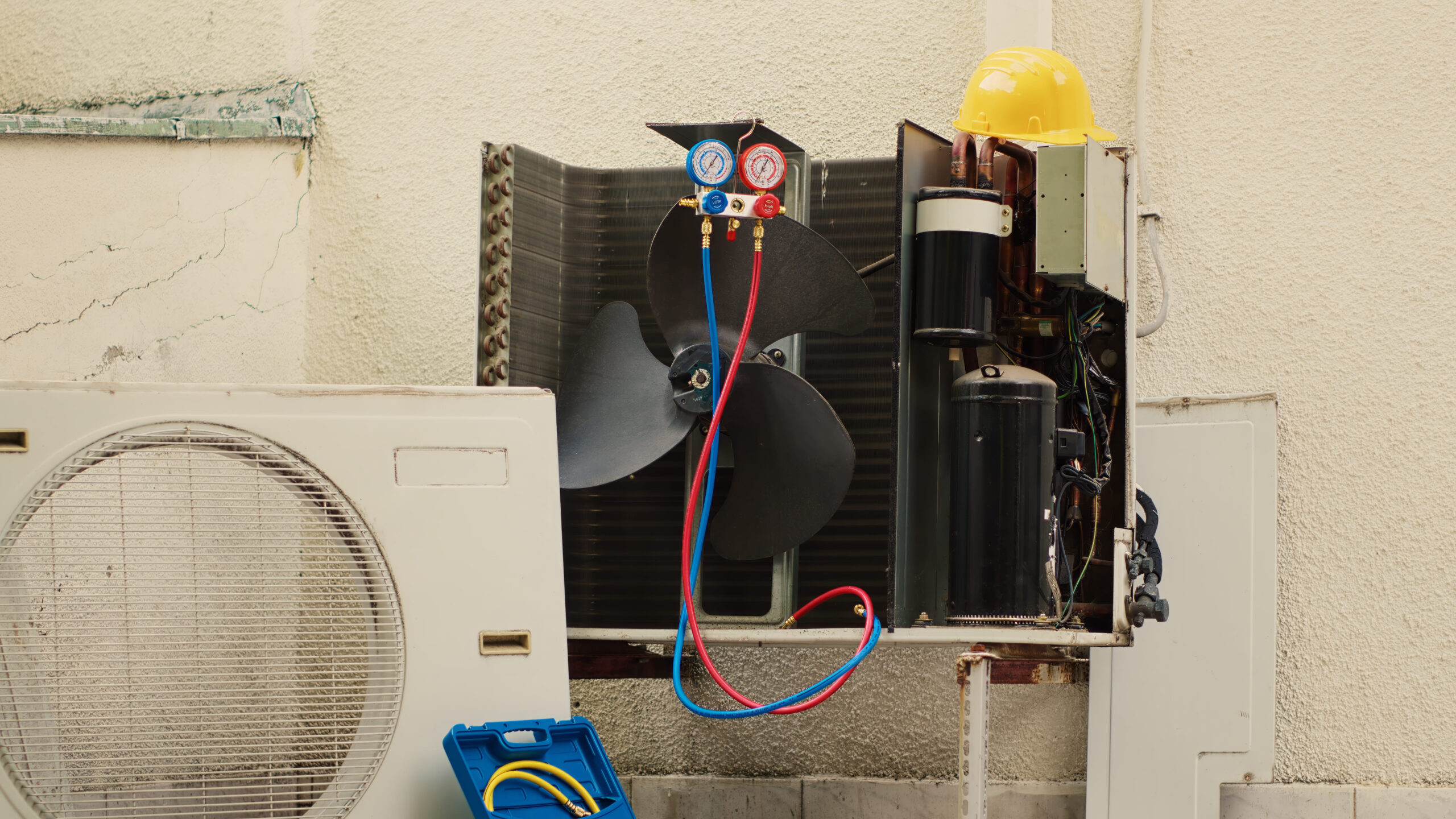
- Evaporation: Refrigerant liquid enters the evaporator coil inside the cold room and absorbs heat from the air, causing it to evaporate into a low-pressure gas. This is what makes the air inside the room cold.
- Compression: The compressor draws in that low-pressure gas and compresses it, raising both its pressure and temperature significantly.
- Condensation: The hot, high-pressure gas moves to the condenser, typically located outside the cold room or externally to the building. Here, heat is released into the surrounding air, and the refrigerant returns to a liquid state.
- Expansion: The liquid refrigerant passes through an expansion device, which reduces its pressure rapidly. This prepares the refrigerant to absorb heat again when it re-enters the evaporator.
As confirmed by cold storage refrigeration principles, cold rooms depend on a vapour-compression refrigeration cycle covering evaporation, compression, condensation, and expansion, with each component playing a critical role in maintaining stable internal temperatures.
Understanding how this compares to standard refrigeration helps clarify why cold rooms require specialist design and installation.
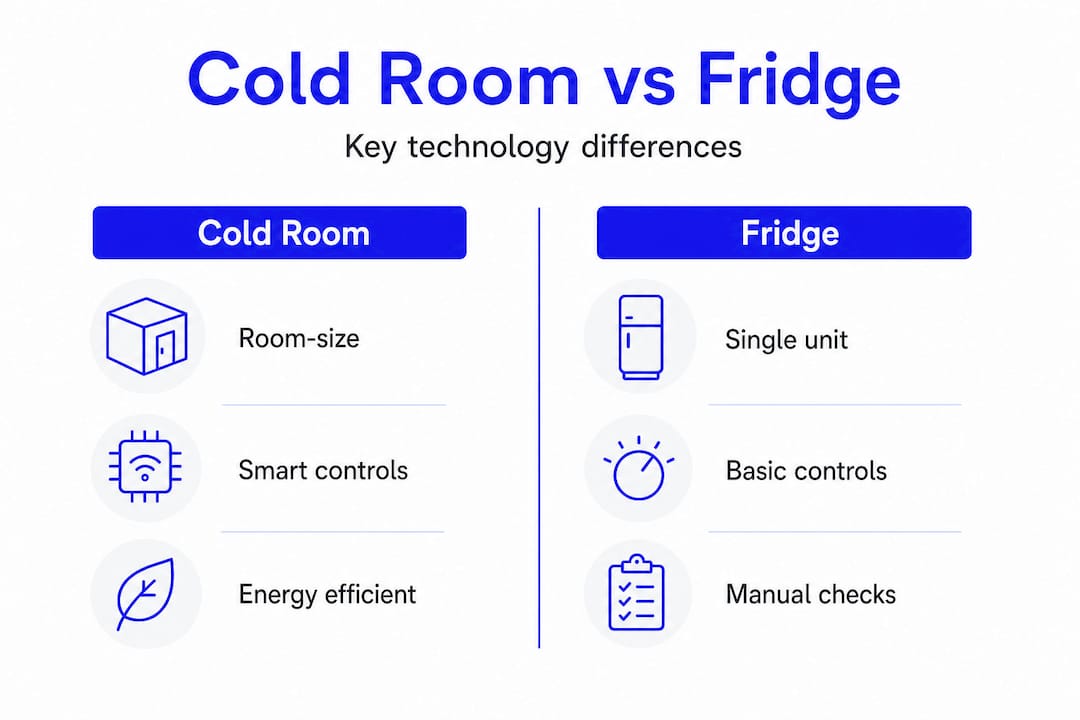
| Feature | Cold room | Standard commercial refrigerator |
|---|---|---|
| Scale | Room-sized, walk-in | Freestanding unit |
| Temperature control | Precision digital controls | Basic thermostat |
| Access frequency | High, multiple personnel | Low to moderate |
| Energy management | Programmable, monitored | Fixed cycle |
| Customisation | Fully tailored | Limited |
| Compliance documentation | Required (food safety) | Typically basic |
A common misconception is that colder always means safer or better. In practice, running a cold room significantly below its required setpoint wastes energy, can cause condensation and frost build-up on stock, and places unnecessary strain on the compressor. Precision matters far more than extreme cold.
Pro Tip: When specifying a new cold room, always confirm the exact temperature range required for each product category. Running a chiller at minus 2°C when plus 2°C is adequate adds cost without any safety benefit. Working with experienced engineers helps you choose commercial refrigeration that matches your actual needs rather than over-specified assumptions.
Smart controls and energy optimisation in modern cold rooms
The gap between a basic cold room and a modern, efficiently managed one is not just about insulation thickness or compressor power. It is almost entirely about controls.
Modern cold room control systems include a range of technologies that older installations simply did not offer:
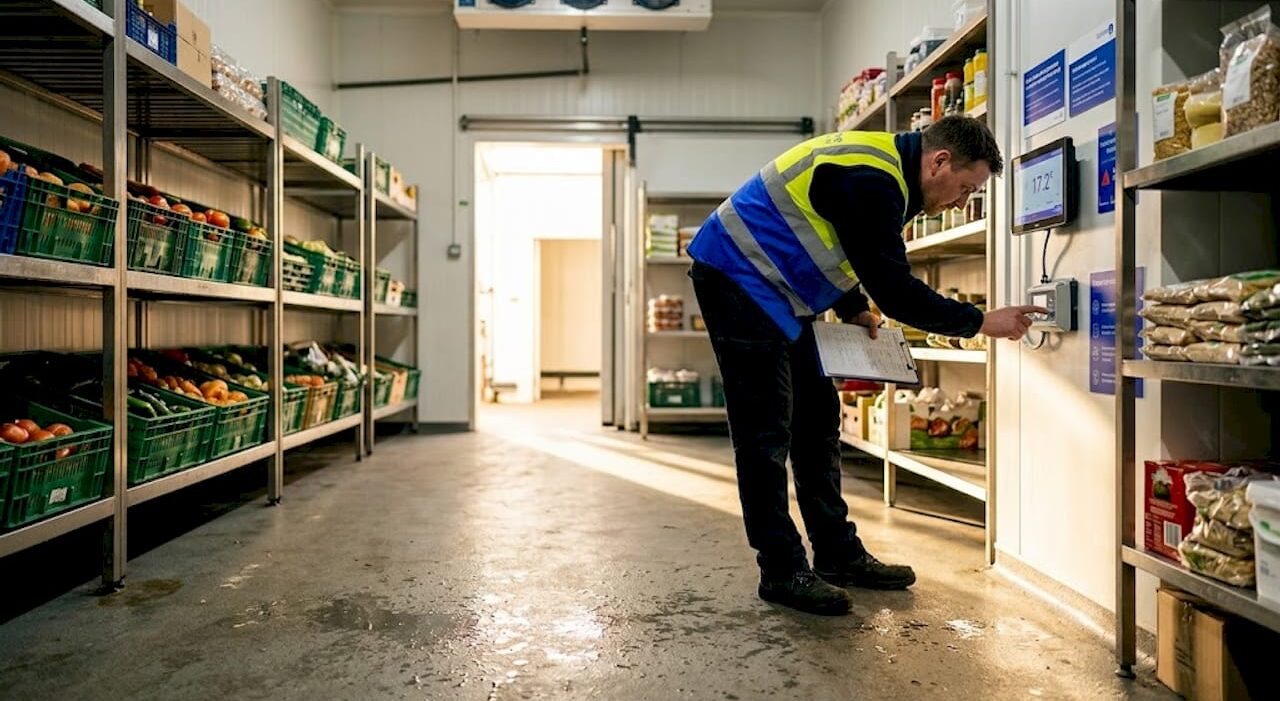
- Temperature sensors positioned at multiple points within the room, not just at a single location near the evaporator
- Continuous data logging that records temperature history for compliance, HACCP (Hazard Analysis and Critical Control Points) audits, and insurance purposes
- Automated alarms that alert managers immediately if temperature drifts outside safe parameters, even out of hours
- Remote monitoring via mobile or web interface, allowing facility managers to check status without being on-site
- Defrost cycle management that minimises temperature fluctuations during planned defrosts
- Fan delay controls that prevent the evaporator fan from running immediately after a defrost cycle, avoiding the distribution of warm air throughout the room
The operational impact of these features is measurable. Smart monitoring and controls can cut energy costs significantly, with one facility management case study recording a 22% reduction in energy expenditure after implementing smart monitoring, plus a reduction in reactive maintenance callouts. Technologies such as delayed fan starts prevent temperature spikes that can compromise stock quality and shorten shelf life.
| Technology feature | Benefit | Manual vs. automated |
|---|---|---|
| Multi-point temperature sensors | Accurate, representative readings | Automated |
| Data logging | Compliance records, trend analysis | Automated |
| Automated alarms | Immediate fault notification | Automated |
| Remote monitoring | Off-site visibility | Automated |
| Defrost cycle control | Reduced temperature swings | Automated |
| Fan delay start | Prevents warm air distribution | Automated |
| Energy reporting | Identifies inefficiencies | Automated |
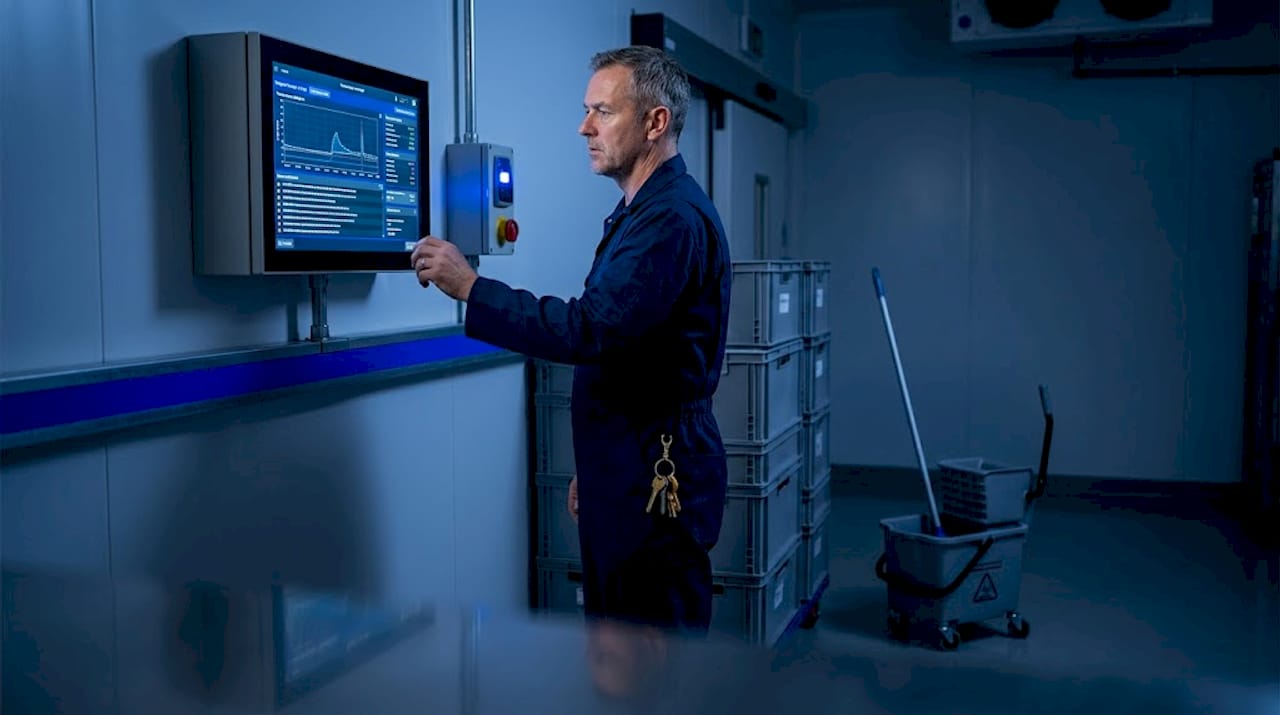
Investing in energy-efficient cold storage is increasingly straightforward. Retrofitting smart controls to an existing cold room is often more affordable than businesses expect, and the return on investment can be achieved within one to two years through energy savings alone.
Pro Tip: If your current cold room does not have remote temperature monitoring with automated alerts, this single upgrade delivers more operational value than almost any other improvement. Explore smart refrigeration tips to understand where the best returns lie for businesses at different stages of their refrigeration maturity.
Selecting the right cold room for your business needs
Choosing a cold room is not simply a matter of picking the largest available option within budget. The right specification depends on a careful assessment of your operation, your products, and your plans for growth.
Start by working through these key assessment steps:
- Define your product types: Chilled goods, frozen products, and fresh produce each require different temperature ranges and humidity levels. A single cold room cannot always serve all categories effectively.
- Calculate your volume requirements: Base your size estimate on peak stock levels, not average ones. Running out of cold storage during a busy period is a costly problem.
- Assess access frequency: High-traffic cold rooms, such as those in busy restaurant kitchens, need robust door hardware, anti-condensation door frames, and possibly strip curtains or air curtains to manage the thermal impact of frequent opening.
- Review your space layout: Column positions, ceiling heights, existing drainage, and electrical supply all affect installation options and costs.
- Plan for future expansion: It is almost always more cost-effective to slightly oversize a cold room at installation than to extend or replace it within a few years.
When speaking to installers and suppliers, ask the right questions:
- What is the projected annual energy consumption for this specification?
- What maintenance schedule is recommended, and what does it include?
- Is the refrigeration unit serviceable with locally available parts?
- What alarm and monitoring systems are included as standard?
- What is the warranty on both the insulated panels and the refrigeration equipment?
- Are your engineers F-Gas certified and experienced with installations of this scale?
Operational controls tailored to business-specific needs deliver measurable savings and compliance benefits. This is not a generic claim. It is a practical reality for businesses that take the time to specify correctly rather than defaulting to the lowest initial cost.
Pro Tip: Always request projected energy costs and a recommended maintenance programme alongside the upfront installation quote. A cheaper cold room that costs more to run and maintain is not a saving. Reviewing restaurant refrigeration options and cost-efficient refrigeration comparisons will give you a clearer picture of what best-practice specifications actually look like.
Working with experienced, specialist providers matters here. An installer who understands the regulatory requirements, product-specific temperature needs, and energy efficiency standards relevant to UK food businesses will deliver a system that performs reliably for years. A generalist who treats cold rooms as interchangeable with other construction work is unlikely to deliver the same result.
The missing link: Why most businesses underuse cold room technology
In our experience working across the UK food service and manufacturing sectors, the most common problem is not that businesses have the wrong cold room. It is that they have a reasonable cold room and are getting far less value from it than they should be.
Cold rooms tend to be treated as background infrastructure. Once installed, they are expected to run quietly in the background while attention goes to everything else. Upgrades are deferred. Monitoring is minimal. Staff are not trained to understand what the alarm panel actually means. And when something goes wrong, it is treated as an unexpected emergency rather than a preventable event.
This thinking is costly. Smart controls and monitoring upgrades are consistently deferred because the upfront cost feels significant compared to the status quo. Yet the savings and reliability gains almost always outweigh the investment, often within two years or less. A business running a cold room without proper monitoring is, in effect, accepting risk that it does not need to carry.
The biggest mistake we see is businesses focusing entirely on capacity during the purchasing decision. How much space do we need? What is the lowest price for that footprint? These are not the wrong questions, but they are incomplete ones. Controls, monitoring, future-proofing, and maintenance access are just as important as square metreage and initial cost.
Practical improvements often come from details. Staff training on correct loading practices, door discipline, and alarm response can meaningfully reduce temperature fluctuations. A planned maintenance schedule, not just a reactive repair relationship, extends equipment life and prevents the kind of compressor failures that cause stock loss at the worst possible time. Data monitoring turns a passive system into one that actively informs operational decisions.
The businesses that get the most from their cold room investment are those that treat it as a managed asset rather than a fixed installation. Reviewing your efficiency strategies periodically, even if your system is relatively new, is a habit that consistently pays dividends.
Next steps: Reliable cold room solutions for your business
If this article has prompted you to reconsider how your cold room is specified, monitored, or maintained, the next step is a conversation with engineers who understand the detail.
EcoFrost HVAC works with food service providers, manufacturers, and facilities teams across the UK to design and install cold rooms that genuinely fit the operation. Every project begins with a thorough site survey and a specification built around your products, your space, and your compliance requirements, not an off-the-shelf template. Our engineers are fully F-Gas certified and supported by ongoing maintenance programmes and emergency cover.
Whether you are planning a new bespoke cold room installation, exploring the full range of cold room categories suited to your sector, or looking into fridge and freezer installation as part of a broader refrigeration upgrade, we provide clear, upfront guidance and reliable support at every stage. Get in touch to arrange a site survey or request a tailored quote.
Frequently asked questions
What makes cold room technology different from standard refrigeration?
Cold room technology provides precision-controlled environments at a commercial scale, with dedicated controls, data logging, and compliance features that standard domestic or basic commercial refrigeration cannot match. As confirmed by cold storage principles, cold rooms use the same vapour-compression cycle but engineered to a fundamentally different standard.
How can smart cold room controls save my business money?
Smart sensors and automated monitoring systems optimise energy use and flag faults before they escalate. Evidence from facility management case studies shows smart controls delivering a 22% reduction in energy costs alongside lower reactive maintenance spend.
What size cold room do I need for my restaurant or facility?
Assess your peak stock volumes, product temperature requirements, access frequency, and available floor space with your installer, then factor in realistic growth projections to avoid undersizing within the first few years of operation.
Can I retrofit my current cold room with smart controls?
Yes. Most modern monitoring and control technologies, including remote sensors, data loggers, and automated alarm systems, can be retrofitted to existing cold rooms without full replacement of the refrigeration unit or insulated structure.
How often should cold rooms be serviced?
At a minimum, cold rooms should be professionally serviced annually, covering refrigerant checks, electrical connections, door seals, evaporator coils, and control systems. Higher-use installations in busy food service environments typically benefit from more frequent planned maintenance visits.