
TL;DR:
- Proper maintenance of commercial kitchen equipment is essential for safety, compliance, and prolonging asset lifespan. Prioritizing high-risk items like gas appliances and refrigeration with routine inspections prevents costly failures and food safety issues. Engaging staff through clear ownership, regular checklists, and management support fosters a culture of proactive maintenance for reliable kitchen operations.
Commercial kitchen equipment represents one of the largest investments a restaurant makes, yet maintenance is often the first thing that slips when service gets busy. A single compressor failure or a faulty gas line can halt an entire operation, trigger regulatory action, and put staff and customers at genuine risk. UK law places clear obligations on operators to keep equipment safe, inspected, and documented. This article delivers practical, actionable maintenance tips to help you protect that investment, stay compliant, and run a safer, more efficient kitchen every day.
Table of Contents
- Why structured maintenance matters in UK kitchens
- High-risk equipment: What demands priority?
- Essential daily, weekly, and annual checks
- The power of staff engagement and maintenance ownership
- Benefits of proactive versus reactive maintenance
- Why UK kitchens struggle with maintenance and what actually works
- Next steps: Professional support for reliable equipment
- Frequently asked questions
Key Takeaways
| Point | Details |
|---|---|
| Follow UK legal standards | Regular equipment maintenance is required by law and critical for safety and reliability. |
| Prioritise high-risk equipment | Give special attention to gas appliances, refrigeration, and electrical systems for inspections. |
| Schedule and document checks | Assign maintenance tasks by name and keep logs to ensure accountability and compliance. |
| Proactive beats reactive | Investing in routine maintenance saves money and headaches compared to fixing breakdowns. |
Why structured maintenance matters in UK kitchens
Running a busy restaurant means equipment is under constant pressure. Ovens cycle through hundreds of hours of heat. Refrigeration units run without pause. Extraction systems battle daily grease build-up. Without a structured maintenance plan, small faults accumulate until something fails at the worst possible moment.
UK law is clear on this. Employers have a legal duty under the Health and Safety at Work Act 1974 and associated regulations to keep equipment maintained in a safe condition. This means inspections must be carried out by competent staff, faults must be logged, and records must be kept. An effective maintenance regime prevents accidents and ensures reliable catering equipment throughout its working life.
Neglecting maintenance does not just create safety risks. It inflates insurance premiums, increases the likelihood of claims, and can lead to enforcement action from environmental health officers. A proactive approach saves money in the long run by catching faults before they become failures.
“Absence of an effective maintenance regime is a significant cause of catering accidents.” — HSE Catering Equipment FAQs
A good maintenance plan also extends equipment lifespan considerably. Commercial refrigeration units, for example, can last well over a decade with proper care, but might fail within five years if gaskets, condensers, and fans are left unchecked. Choosing to save costs with regular maintenance is one of the most straightforward financial decisions a kitchen manager can make.
Key reasons why structured maintenance matters:
- Reduces the risk of unexpected breakdowns during busy service periods
- Keeps your business compliant with HSE and local authority requirements
- Protects staff safety and reduces accident liability
- Maintains food safety standards by ensuring refrigeration performs correctly
- Prolongs equipment life, reducing capital expenditure
High-risk equipment: What demands priority?
Not every piece of kit carries the same risk when it fails. Prioritising your maintenance effort around the highest-risk equipment is the practical starting point for any restaurant team.
Gas appliances, ventilation, refrigeration, dishwashers, and electrical components need regular inspection and, where required, formal certification. Here is a breakdown of the priority categories most relevant to UK restaurant kitchens:
| Equipment type | Key risk | Inspection requirement |
|---|---|---|
| Gas cookers and ovens | Fire, explosion, carbon monoxide | Annual by Gas Safe engineer |
| Cold rooms and refrigeration | Food spoilage, Listeria risk | Ongoing checks, servicing every 6 months |
| Extraction and canopy fans | Grease fire, poor air quality | Quarterly professional clean |
| Dishwashers | Electrical fault, scalding | Monthly inspection, PAT testing annually |
| Electrical appliances | Electric shock, fire | PAT testing annually, visual checks weekly |
Gas equipment sits at the top of this list. A faulty gas connection or a worn burner seal does not just affect performance. It creates genuine life-safety risks. Only a Gas Safe registered engineer should carry out gas inspections and repairs.
Refrigeration is mission-critical for food safety. A cold room or fridge that loses temperature overnight can result in thousands of pounds of spoiled stock and a potential food poisoning incident. Regular cleaning and servicing keeps these units performing as intended. Knowing the basics of cleaning refrigeration units is a practical skill every kitchen supervisor should have.
Extraction systems are frequently underestimated. Grease-laden air passing through a dirty canopy creates conditions for a kitchen fire. Quarterly professional cleaning is not optional in a high-volume kitchen.
Pro Tip: Build a risk-priority checklist for your kitchen and assign each category a review frequency. Stick it in the staff room and review it monthly. A visual prompt reduces the chance that any category gets overlooked during a busy period.
Essential daily, weekly, and annual checks
Good maintenance does not require a full shutdown or a team of engineers. Most of it is built into daily and weekly routines that any trained team member can follow.
Here is a structured approach to scheduling checks across different time frames:
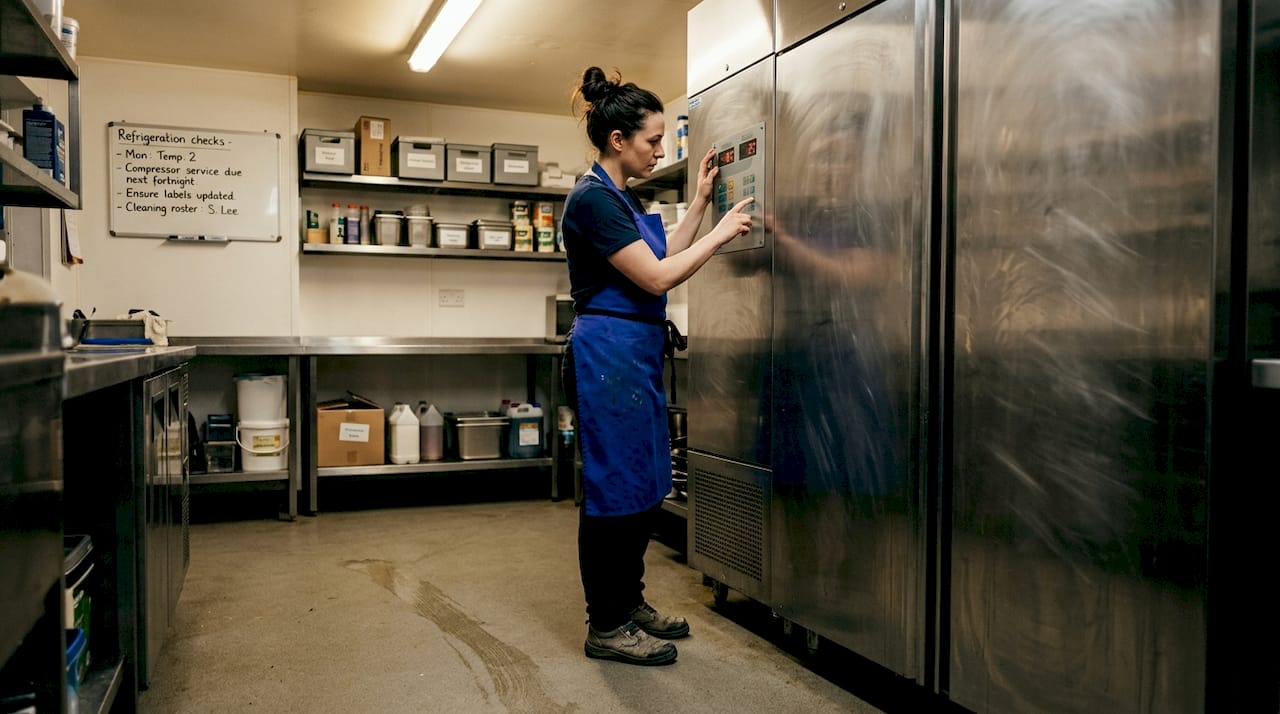
- Daily checks: Wipe down all cooking surfaces, check refrigeration temperatures and log them, inspect seals and door gaskets on fridges and cold rooms, clear any grease from around hob burners, and report faults immediately using a written or digital fault log.
- Weekly checks: Inspect gaskets and door seals more thoroughly for cracks or tears, clean condenser coils on under-counter fridges, test thermometers for accuracy, check extraction filters for grease accumulation, and review fault logs from the past seven days for patterns.
- Monthly checks: Deep clean extraction canopies and fan blades, inspect dishwasher spray arms and check water temperature settings, review all equipment logs and cross-reference against manufacturer guidance, and test emergency shut-off systems on gas ranges.
- Six-monthly checks: Commission a professional refrigeration service, including compressor inspection, refrigerant levels, and condenser cleaning. This is especially important for walk-in freezer maintenance, where a small fault can quickly become a costly failure.
- Annual checks: Annual inspections by a competent person are the reasonable minimum for gas equipment. You should also complete PAT testing for all portable appliances, arrange deep cleans of all extraction ductwork, and review fridge safety maintenance records to confirm everything is within manufacturer tolerances.
Manufacturer recommendations should always be followed alongside these general guidelines. Some equipment will require more frequent attention depending on usage volume.
Pro Tip: Schedule maintenance tasks directly into your staff rota with a named person responsible. When maintenance appears alongside table prep and opening duties, it becomes a normal part of the shift rather than something that gets deferred.
The power of staff engagement and maintenance ownership
A well-written checklist achieves nothing if no one takes responsibility for completing it. This is where many UK restaurant kitchens fall short. Maintenance becomes everyone’s job in theory and nobody’s job in practice.
Clear ownership of maintenance tasks prevents them being neglected. Assigning routine checks to specific roles, rather than leaving them open to the whole team, creates accountability. A sous chef who owns refrigeration checks will notice changes in temperature logging far sooner than a team that vaguely expects someone else to manage it.
Training matters equally. Staff who understand why a task matters are far more likely to complete it properly. When a chef understands that a failing door gasket on a cold room can raise internal temperatures by several degrees and put food safety at risk, they treat that weekly seal inspection differently.
Practical steps to build genuine maintenance ownership:
- Assign refrigeration checks to a specific role in every shift
- Train new starters in fault identification during induction, not just cooking procedures
- Use a digital log or simple paper checklist that must be signed off after every check
- Review logs weekly with the relevant team member, not just at monthly management meetings
- Recognise and reward consistent maintenance behaviour, particularly when a fault is caught early
“Maintenance is only effective when ownership is clear and scheduled, not an afterthought.”
Using digital tools for logging is increasingly practical even in smaller kitchens. Apps that allow photo documentation of faults and automated reminders for scheduled checks reduce the administrative burden while improving compliance records. This is particularly useful when an environmental health visit requires evidence of routine maintenance. Keeping a clear refrigeration troubleshooting record also helps engineers diagnose issues faster when a callout is needed.
Benefits of proactive versus reactive maintenance
The financial and operational case for proactive maintenance is straightforward. Reactive maintenance, where you wait for something to break before acting, almost always costs more in every dimension.
| Factor | Proactive maintenance | Reactive maintenance |
|---|---|---|
| Cost | Predictable, lower overall | High and unpredictable |
| Downtime | Minimal, planned | Significant, unplanned |
| Food safety risk | Low | High during failure |
| Staff morale | Positive, reliable environment | Stressful, chaotic |
| Insurance premiums | Lower with good records | Higher after claims |
| Equipment lifespan | Extended | Shortened |
| Compliance | Easier to demonstrate | Harder to evidence |
The numbers reinforce this firmly. Absence of a maintenance regime is a significant cause of catering accidents across the UK. Accident costs include not just repair bills but potential legal fees, staff injuries, food disposal, and reputational damage. The cost of an emergency refrigeration callout, stock replacement, and potential closure far exceeds the annual cost of a planned maintenance contract.
Proactive maintenance also has a direct impact on food safety inspection outcomes. An environmental health officer reviewing temperature logs and maintenance records will assess your kitchen very differently from one that finds no records at all. A consistent maintenance history supports your overall food hygiene rating and reduces the chance of a poor outcome from an unannounced inspection.
Choosing cost-effective maintenance routines is not about spending more money. It is about spending it in the right place, at the right time, before a crisis forces the decision for you.
Why UK kitchens struggle with maintenance and what actually works
From our experience working with restaurant kitchens across the UK, the honest truth is this: most operators know what good maintenance looks like. The problem is not knowledge. It is follow-through.
The pressures of service, staff turnover, and cost management mean maintenance slides down the priority list. Checklists get printed and forgotten. Engineers get booked and then cancelled to save money. The cold room that is “running a bit warm” gets monitored rather than fixed. Until it fails on a Friday evening before a full weekend of covers.
The discipline of regular maintenance is not really about engineering knowledge. It is about building a culture where care for equipment is taken seriously at every level, from the head chef who notices a faulty burner seal to the kitchen porter who flags a fridge making an unusual noise.
Real improvement comes from three practical changes. First, leadership must model maintenance behaviour visibly. When a head chef treats a faulty gasket as urgent rather than optional, the team follows. Second, recognition matters. Reward the person who catches a fault early, not just the person who solves the crisis. Third, keep the system simple. A one-page checklist completed daily beats a comprehensive document that takes twenty minutes to fill in and gets abandoned after a week.
“Consistent follow-up, not the length of your checklist, is what keeps your kitchen safe and reliable.”
Pro Tip: Trial a monthly maintenance audit and introduce a small team reward when all checks are completed correctly that month. Changing behaviour takes repetition and positive reinforcement, not just instruction.
Next steps: Professional support for reliable equipment
Running a busy kitchen means your time and energy are already stretched. When it comes to refrigeration, cold rooms, and HVAC systems, professional support takes the complexity off your plate and ensures every system performs to standard.
EcoFrost HVAC works with restaurants across the UK to install and maintain commercial refrigeration and HVAC systems that operators can genuinely rely on. Whether you need cold room solutions designed around your specific storage needs or commercial fridge installation for a growing operation, our F-Gas certified engineers bring the same level of care to every project. We back every installation with ongoing maintenance support and emergency cover, so you have expert help available when it matters most. Get in touch with EcoFrost HVAC to discuss a planned maintenance package that fits your kitchen and your budget.
Frequently asked questions
How often should I have gas kitchen equipment inspected?
Gas kitchen equipment should be inspected at least annually by a competent person, or more frequently if the manufacturer’s guidance requires it.
What are the most common reasons for equipment failure in restaurants?
The most common causes are lack of regular maintenance and failure to train staff to identify early signs of equipment faults before they become serious failures.
Are there legal requirements for kitchen equipment checks in the UK?
Yes, employers must maintain all gas, electrical, and mechanical kitchen equipment in a safe condition, as required by UK health and safety law and HSE guidance.
How can I make sure my staff follow the maintenance routine?
Assign maintenance tasks to specific named staff members and use checklists or digital logs to track and confirm completion at every shift.
What are the benefits of regular maintenance for restaurant equipment?
Good maintenance prevents accidents, keeps equipment reliable, reduces costly downtime, supports food safety compliance, and helps your business demonstrate due diligence to inspectors.