
TL;DR:
- A failing chiller without warning can cause costly operational disruptions and breach compliance.
- Consistent, thorough maintenance—relying on proper planning, documentation, and modern monitoring—reduces these risks effectively.
A chiller that fails without warning can halt production lines, spoil perishable stock, trigger F-gas compliance breaches, and leave your facility scrambling for emergency engineers at premium callout rates. For UK facilities managers and business owners, the financial and operational consequences are serious. Yet the majority of preventable breakdowns trace back to one root cause: inconsistent or incomplete maintenance. This guide sets out a practical, structured approach to commercial chiller maintenance, covering everything from pre-checks and daily routines through to seasonal tasks and continuous performance verification, so your systems stay reliable and your operation stays on track.
Table of Contents
- What you need before starting chiller maintenance
- Step-by-step chiller maintenance process
- Seasonal and advanced maintenance tasks
- Verification and continuous improvement
- Why most chiller maintenance routines miss the mark
- Get expert support for your facility’s cooling systems
- Frequently asked questions
Key Takeaways
| Point | Details |
|---|---|
| Prepare before you start | Organise tools, safety gear, permits, and records before beginning any chiller maintenance. |
| Follow structured steps | Use a clear, evidence-backed checklist for routine, seasonal, and advanced tasks. |
| Keep compliance records | Document all maintenance and leak tests for safety and audit readiness. |
| Embrace continuous monitoring | Move towards proactive maintenance with data-driven alerts and performance tracking. |
What you need before starting chiller maintenance
Good maintenance begins before you touch any equipment. Rushing straight to the plant room without the right tools, documentation, or safety controls in place is how mistakes happen and how compliance audits fail.
Essential equipment and materials
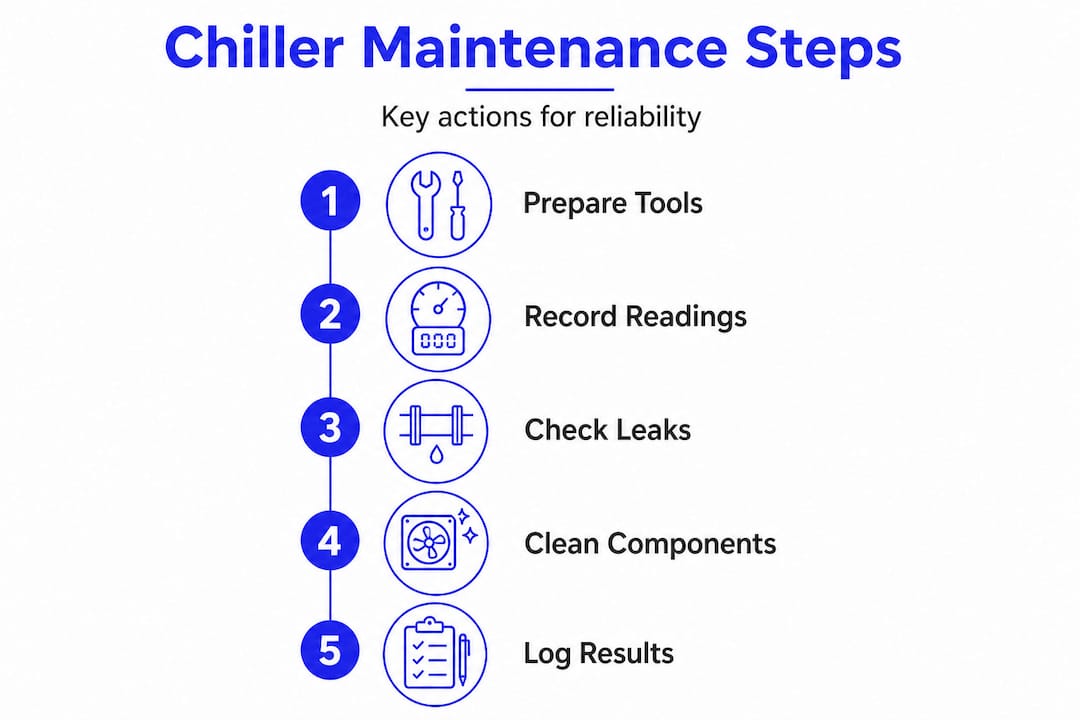
Before any visit, gather the following:
- Calibrated thermometer and pressure gauges
- Leak detection equipment (electronic sniffer or UV dye kit)
- Cleaning brushes, fin combs, and approved coil cleaning solution
- Torque tools and electrical insulation tester
- Personal protective equipment: gloves, safety glasses, and appropriate footwear
- Engineer’s logbook or access to your digital maintenance platform
Understanding commercial chiller basics is equally important before starting. Knowing how your specific unit operates, whether it is air-cooled or water-cooled, scroll or screw compressor, will determine which checks take priority.
Documentation and permits
The paperwork side is not optional. HSE guidance is clear that chiller maintenance must explicitly cover system safety measures, including inspection, leak detection, and a permit-to-work approach in high-hazard contexts, not merely performance and efficiency checks. Before starting work, confirm:
- A valid permit-to-work is in place where required
- Your F-gas log is up to date and accessible
- Previous maintenance records are available for reference
- Any isolation procedures are documented and followed
| Tool or document | Purpose in maintenance |
|---|---|
| Calibrated thermometer | Logging leaving and return water temperatures |
| Pressure gauges | Recording high and low side refrigerant pressures |
| Leak detection kit | Identifying refrigerant escape points |
| F-gas log | Compliance record of refrigerant quantities and tests |
| Engineer’s logbook | Audit trail for all work and readings |
| Permit-to-work form | Safety authorisation for work on live or isolated systems |
Pro Tip: Set up a dedicated digital log, even a simple shared spreadsheet, to record every visit’s readings, findings, and actions. A consistent audit trail demonstrates compliance and makes trend analysis straightforward when performance issues emerge later.
Step-by-step chiller maintenance process
With preparations complete, you are ready to carry out the hands-on checks. The following numbered process covers the core activities for a standard maintenance visit, whether you are conducting a weekly inspection or a more detailed monthly review.
-
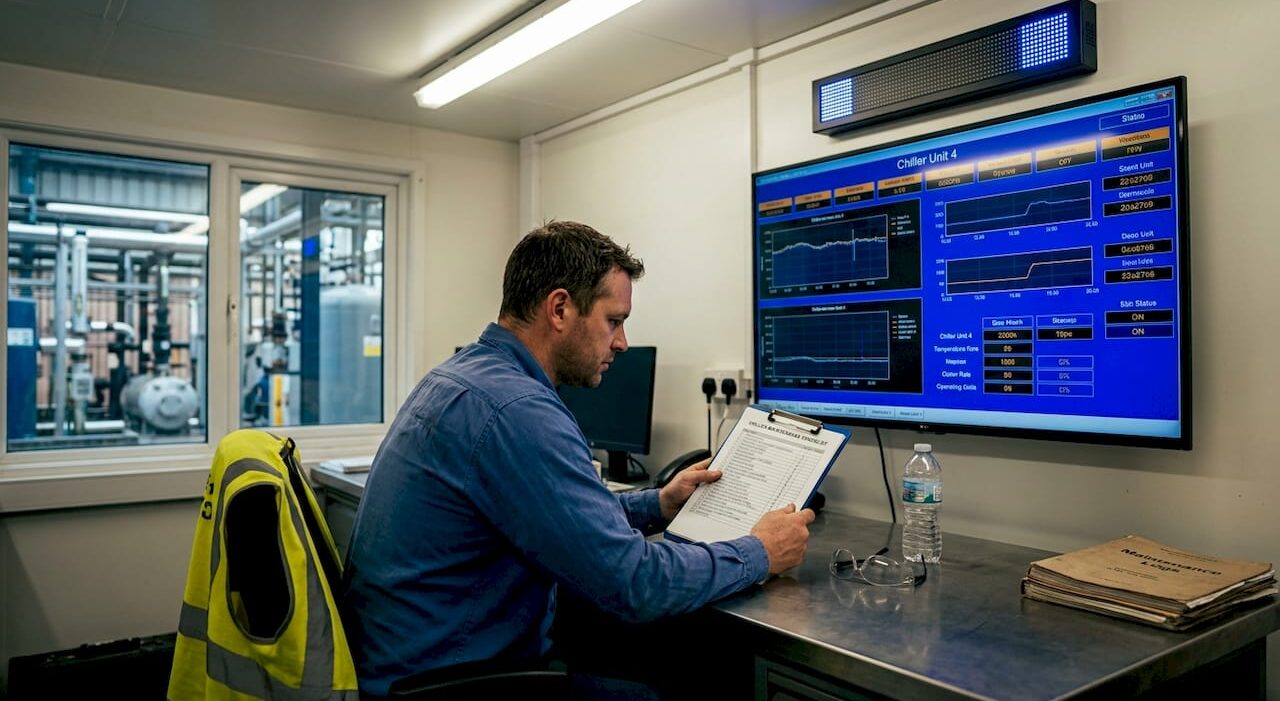
Record baseline temperatures and pressures. Log the chilled water flow and return temperatures, the condenser inlet and outlet temperatures, and the high and low side refrigerant pressures. These figures form your performance baseline and reveal efficiency drift over time.
-
Conduct a visual inspection. Walk around the entire unit and look for signs of refrigerant leaks (oil staining around joints and service valves), physical damage, unusual vibration, or excessive noise from the compressor or fans. Early visual warning signs, as reinforced by operational check guidance, are often the fastest way to catch a developing fault before it becomes a breakdown.
-
Check alarms and fault history. Review the controller’s alarm log. Repeated alarms, even if they have auto-reset, are a clear signal that something is drifting. Dismiss nothing without understanding why it triggered.
-
Confirm water flow and setpoints. Verify that flow rates are within design parameters and that temperature setpoints match the current operational requirements. A setpoint that has drifted, or been overridden and forgotten, can cause the entire system to work harder than necessary.
-
Inspect electrical connections and controls. Check that contactors, fuses, and control wiring are in good condition. Loose electrical connections are a common cause of intermittent faults and compressor trips.
-
Test safety devices. Confirm that high-pressure switches, low-pressure switches, and flow switches are all functional. These are your last line of defence against serious equipment damage.
-
Check and clean strainers and filters. Blocked strainers restrict flow and force the system to work harder, directly increasing energy consumption and wear.
-
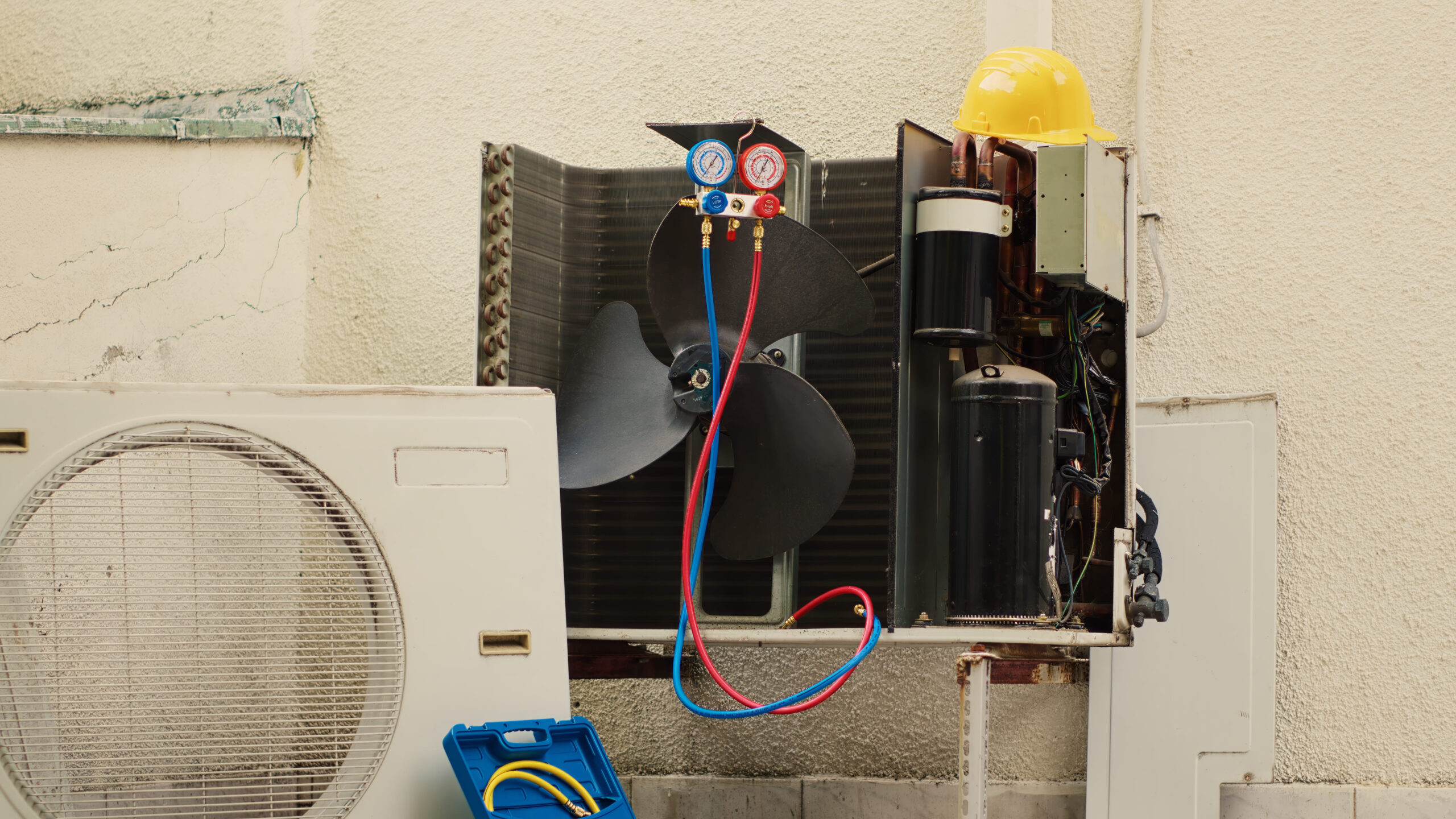
Clean accessible coil surfaces. For refrigeration units requiring cleaning, use appropriate coil cleaner and a soft brush to remove debris build-up from condenser fins. This is one of the highest-impact tasks in terms of energy efficiency.
-
Test for refrigerant leaks. Use your electronic sniffer or UV lamp to check all joints, valve packing, and brazed connections. Never defer leak testing to a scheduled date alone.
-
Update all records. Log every reading, observation, and action taken before leaving the plant room.
“Day-to-day and operational checks should focus on logging performance parameters such as temperatures and pressures, watching for alarms and trips, confirming flow and setpoints, and identifying early visual warning signs including leaks, oil staining, and vibration or noise.” This approach is the foundation of consistent chiller reliability.
Maintenance frequency comparison
| Task | Daily | Weekly | Monthly | Annual |
|---|---|---|---|---|
| Log temperatures and pressures | ✓ | ✓ | ✓ | ✓ |
| Visual inspection for leaks | ✓ | ✓ | ✓ | ✓ |
| Review alarm history | ✓ | ✓ | ✓ | ✓ |
| Clean strainers and filters | ✓ | ✓ | ✓ | |
| Electrical connection check | ✓ | ✓ | ||
| Full coil clean | ✓ | ✓ | ||
| Safety device testing | ✓ | ✓ | ||
| F-gas leak test (formal) | ✓ | |||
| Full system overhaul | ✓ |
For a full picture of how maintenance fits into the broader operational lifecycle, the refrigeration installation guide for facilities provides useful context on system design and commissioning standards.
Pro Tip: Never treat leak detection as an annual box-tick. At every maintenance visit, regardless of frequency, run a quick sniff test around joints and valve packing. Refrigerant loss is cumulative, expensive, and a direct compliance liability.
Seasonal and advanced maintenance tasks
Not every maintenance task happens at the same frequency. Seasonal checks are among the highest-value activities a facilities team can undertake, yet they are often the first to be postponed when operational pressure builds. That is a costly trade-off.
Key seasonal maintenance tasks
Seasonal maintenance should always include cleaning and inspecting the heat rejection side of the system, particularly condenser coils, air paths, and fin faces on air-cooled units, to prevent airflow restriction and efficiency losses:
- Clean condenser coils and fin faces using appropriate non-corrosive coil cleaner
- Remove debris, leaves, and blockages from around air-cooled condensers
- Inspect and clean cooling tower fill, drift eliminators, and distribution nozzles on water-cooled systems
- Check glycol concentration in chilled water circuits and adjust for seasonal temperature changes
- Inspect all pipe insulation for damage, condensation, or deterioration
- Test and calibrate frost protection controls ahead of winter
- Inspect expansion vessels and pressurisation units
- Verify that any weatherproofing on outdoor units is intact and undamaged
Harsh environments and critical operations
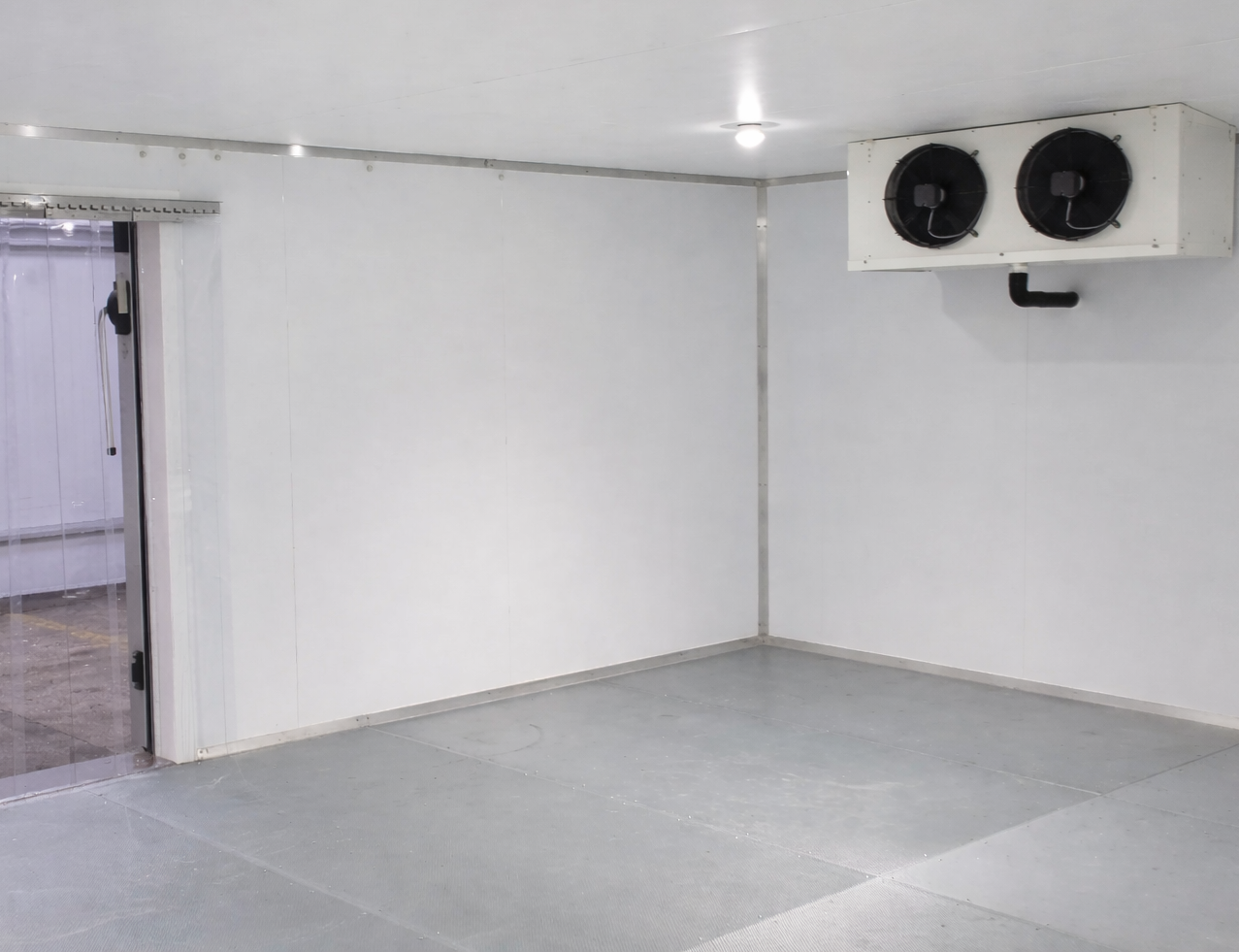
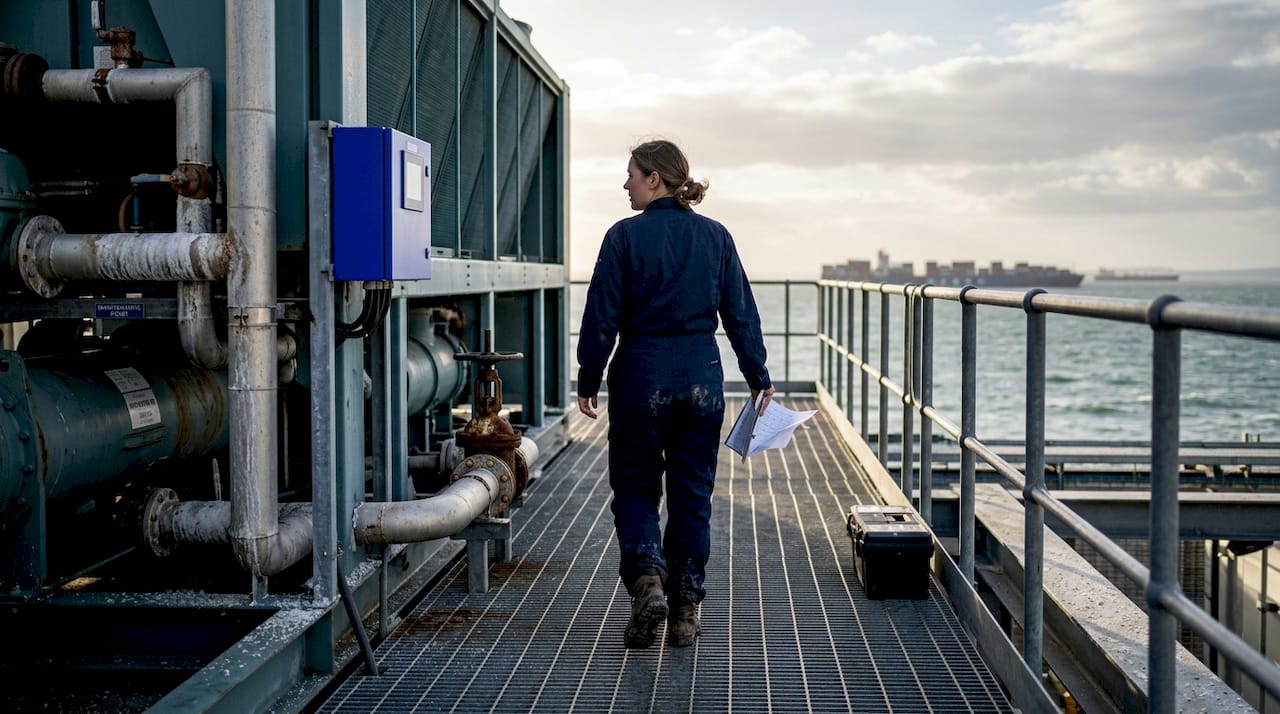
Facilities in harsh environments, such as coastal sites where salt air accelerates coil corrosion, or cold store operations where defrost cycles run continuously, require customised routines. Generic checklists simply do not account for the accelerated wear rates in these settings. If your facility operates in a particularly demanding environment, your maintenance schedule should reflect that reality with more frequent coil inspections and electrical checks.
F-gas compliance requirements
All facilities using refrigerants covered by UK F-gas regulations must carry out formal leak testing at defined intervals based on the system’s equivalent CO2 charge. You must maintain a full audit trail, including dates, quantities, engineer details, and refrigerant type. Failure to do so can result in enforcement action and significant fines. Our guidance on regular maintenance and compliance covers these requirements in more detail.
Pro Tip: Schedule your major seasonal maintenance during a planned shutdown or out-of-hours window. This avoids operational disruption, allows engineers to isolate systems safely, and ensures all cleaning tasks are completed without time pressure.
Verification and continuous improvement
Completing the maintenance tasks is not the end of the process. What you do with the data you collect is what separates a genuine maintenance programme from a paperwork exercise.
Post-maintenance performance verification
Once work is complete, allow the system to return to normal operating conditions and then re-record all key parameters. Compare these figures against your pre-maintenance baseline and against design data. If temperatures have dropped and pressures have normalised after a coil clean, you have measurable evidence that the work delivered a performance improvement. If figures remain unchanged, further investigation is warranted.
Best practices for ongoing records management
- Store all maintenance records digitally with date stamps and engineer signatures
- Keep F-gas leak test certificates alongside service records in a single accessible location
- Record all alarm events, even those that auto-reset, with a brief note on probable cause
- Flag any recurring faults for follow-up investigation rather than repeated reset
- Ensure records are accessible to all relevant personnel, including any contractor engineers
Key indicators to log and what they mean
| Indicator | What it suggests when abnormal |
|---|---|
| Rising suction pressure | Possible refrigerant overcharge or metering valve fault |
| Falling discharge pressure | Low refrigerant charge or compressor wear |
| Increasing leaving water temperature | Reduced heat transfer, possibly dirty coils or low flow |
| Rising energy consumption | System working harder, often due to fouling or refrigerant loss |
| Repeated alarms | Developing fault or incorrect setpoint configuration |
| Reduced chiller capacity | Fouled heat exchanger or refrigerant circuit issue |
Continuous monitoring is reshaping refrigeration service, with modern preventive approaches increasingly using data-driven leak detection and maintenance workflows to move away from purely reactive servicing. Connecting your chiller’s controller to a remote monitoring platform means alerts can trigger an engineer response before a fault escalates into a failure.
For guidance on keeping refrigeration safe across food-related operations, our detailed resource covers temperature monitoring obligations and food safety compliance in practical terms.
Pro Tip: Set threshold alerts on your monitoring platform for parameters such as discharge pressure, leaving water temperature, and energy draw. When a reading drifts beyond a defined range, an automatic alert to your maintenance team enables intervention days or weeks before a breakdown would otherwise occur.
Why most chiller maintenance routines miss the mark
Having laid out a detailed, evidence-backed maintenance approach, it is worth being direct about why so many facilities still experience avoidable chiller failures despite having maintenance contracts in place.
The honest answer is that routine tick-box exercises frequently substitute for genuine performance oversight. An engineer visits, records a set of numbers, cleans what is visible, and signs off. But if nobody is analysing trends across visits, a slow drift in discharge pressure or a steady rise in energy consumption goes unnoticed until the compressor gives out. By then, the repair bill is substantial and the operational disruption is real.
Facilities in critical or demanding environments face a second problem: they are often working from generic maintenance schedules that were not designed for their specific conditions. A food manufacturing facility running 24 hours a day in a warm ambient environment needs a fundamentally different maintenance frequency to a standard office chiller. Applying the same checklist to both is a false economy.
The most significant shift available to UK facilities managers right now is adopting advanced troubleshooting and continuous monitoring as a standard part of their maintenance approach. Data-driven maintenance is not a luxury for large facilities. Remote monitoring solutions are now accessible and affordable for most commercial systems, and the cost of an early intervention is almost always a fraction of an emergency repair.
Rethinking maintenance as ongoing risk management, rather than a compliance obligation to be discharged as quickly as possible, is the change that makes a genuine difference to system longevity, energy costs, and operational reliability.
Get expert support for your facility’s cooling systems
Putting a structured maintenance programme in place is the right approach, but having the right engineering team behind you makes it far more effective. EcoFrost HVAC works with facilities managers and business owners across the UK to keep commercial refrigeration and HVAC systems running reliably, from planned maintenance programmes through to emergency cover when something goes wrong.
Whether you need a full review of your coldroom solutions, fast access to repair and emergency services when a fault develops, or professional guidance on fridge and freezer installation to replace ageing equipment, our F-Gas certified engineers are ready to help. We provide clear, upfront quotes and back every job with ongoing support so your facility is never left without expert cover. Get in touch with EcoFrost HVAC today to discuss your maintenance requirements.
Frequently asked questions
How often should commercial chillers be maintained?
Most commercial chillers require basic checks daily or weekly and a full seasonal or annual service for cleaning, leak testing, and safety documentation. Removing debris and cleaning coils is a core part of scheduled seasonal visits to prevent overheating and capacity loss.
What records must be kept for chiller maintenance?
You should keep logs of performance readings, alarms, maintenance work, and F-gas leak testing for compliance and audit purposes. Maintenance records should reflect all readings, alarms, performance drift, and refrigerant leak testing carried out by competent, certified engineers.
Which chiller components need the most attention?
Focus on condenser coils, controls, refrigerant levels, and safety devices for reliable and efficient performance. Operational checks should cover temperatures, pressures, alarms, flow rates, and early visual signs such as leaks, oil staining, and unusual vibration.
What is the benefit of continuous monitoring for chiller maintenance?
Continuous monitoring and data-driven alerts can detect issues early, reduce emergency repairs, and support planned interventions. Modern preventive approaches increasingly use real-time data and automated workflows to move decisively away from purely reactive servicing.