
TL;DR:
- From July 2026 high-GWP refrigerants will be banned in new systems, requiring natural alternatives.
- Natural refrigerants like CO2 and R290 are becoming standard for compliance and operational efficiency.
- Smart controls and energy-efficient tech reduce costs, improve maintenance, and enhance regulatory compliance.
Meeting strict F-Gas compliance requirements while controlling energy costs is one of the most pressing challenges for food service and retail businesses right now. From July 2026, bans on high-GWP refrigerants above GWP 150 come into force, forcing a fundamental rethink of system choices across the industry. The businesses that plan ahead will gain a genuine competitive edge, while those that delay face compliance risk, rising running costs, and potential disruption to operations. This article breaks down the four key trends shaping commercial refrigeration in 2026, so you can make informed decisions about your next upgrade.
Table of Contents
- How new regulations and sustainability targets drive your options
- Trend 1: Natural refrigerants and the drive to net zero
- Trend 2: Smart tech, IoT, and predictive maintenance in 2026
- Trend 3: Efficiency tech, cost breakdowns, and what pays off fastest
- Refrigeration decisions for 2026: What most guides get wrong
- Need help upgrading commercial refrigeration in 2026?
- Frequently asked questions
Key Takeaways
| Point | Details |
|---|---|
| Regulations change system choices | New F-Gas bans and carbon targets will limit refrigerant and equipment options by 2026. |
| Natural refrigerants dominate | R290 and CO2 offer compliance, operational savings, and futureproofing for most businesses. |
| Smart tech is essential | Predictive monitoring, IoT, and VSDs now standardly cut failures and boost energy savings. |
| Efficiency upgrades pay back quickly | Technologies like VSDs and floating head pressure provide double-digit savings within a few years. |
How new regulations and sustainability targets drive your options
With the 2026 context set, businesses must next understand what legislation and efficiency standards require, and what that means for their next refrigeration investment. The regulatory landscape has shifted considerably, and the consequences of getting it wrong go well beyond a fine.
The F-Gas phase-down is the most significant driver. High-GWP refrigerant bans from July 2026 mean that many systems using HFCs such as R404A and R507 are no longer viable for new installations. If your current equipment relies on these gases, servicing costs will rise sharply as supply tightens. Understanding refrigeration compliance in 2026 is no longer optional for any business running commercial cold storage.
Sustainability targets are adding further pressure. Many retailers and food service operators are now required to report carbon footprints as part of supply chain agreements or local authority contracts. Refrigeration is often the single largest energy consumer on site, so it sits squarely in the crosshairs of any credible net-zero strategy. A sustainable refrigeration guide can help you map out what a lower-carbon system looks like in practice for your type of operation.
Here is what the new regulatory environment means for your system choices:
- HFC refrigerants above GWP 150 are banned from new commercial refrigeration systems from July 2026
- Natural refrigerants (R290, CO2, hydrocarbons) are now the primary compliant options for most applications
- Energy efficiency ratings are increasingly tied to planning permissions and procurement criteria
- Leak detection and F-Gas record-keeping requirements remain strict and are subject to inspection
Efficiency benchmark: Best-in-class frozen stores use 25 to 35 kWh/m³ per year. The industry average sits at 50 to 80 kWh/m³. If your site is closer to the average, there is significant room to cut costs through the right system choices.
Compliance is not just about avoiding penalties. It is about locking in lower running costs and future-proofing your asset base before the market tightens further.
Trend 1: Natural refrigerants and the drive to net zero
Once you understand why low-GWP choices matter, you can explore which refrigerant and system makes sense under the new rules. Natural refrigerants are not a niche option anymore. They are rapidly becoming the standard for any new commercial refrigeration installation.
The two most relevant options for food service and retail businesses are CO2 (R744) and propane (R290). Both have near-zero GWP, which means they carry no regulatory risk going forward. The shift to natural refrigerants is being driven by F-Gas legislation, but businesses that have already made the switch report operational benefits well beyond compliance.
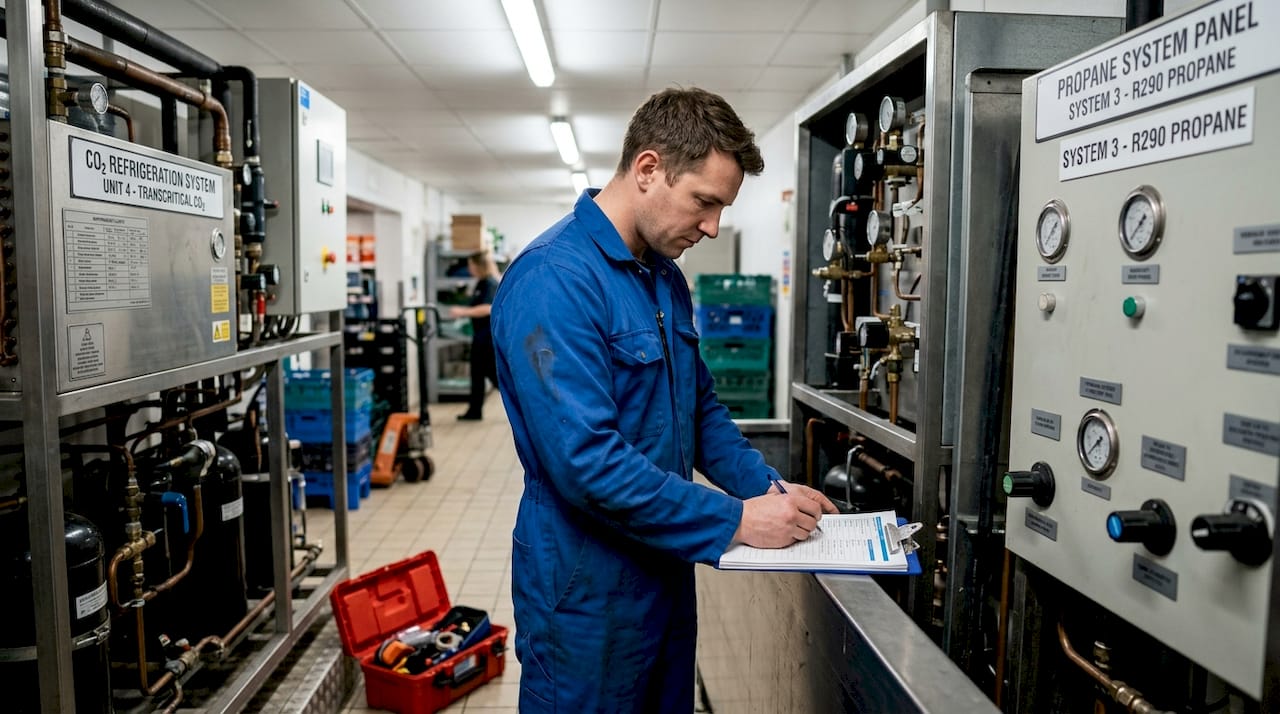
CO2 systems are particularly well suited to larger operations such as supermarkets, distribution centres, and large food production facilities. Despite higher upfront capital costs, CO2 systems offer lower TCO and heat recovery savings of 15 to 30%, which can offset installation costs over a three to five year horizon. There is also no phaseout risk, which protects your investment for the long term.
Propane (R290) is the preferred choice for smaller, self-contained units such as display cabinets, undercounter fridges, and small cold rooms. It is simple to install, widely supported by manufacturers, and performs efficiently across a broad range of ambient temperatures. For smaller food service businesses and independent retailers, R290 offers a practical route to compliance without the complexity of a CO2 system.
Key operational points to keep in mind:
- R290 requires charge limits per unit (typically under 150g) and appropriate ventilation in enclosed spaces
- CO2 systems need trained engineers familiar with transcritical operation, especially in warmer climates
- Both refrigerants are compatible with the range of restaurant refrigeration types available in 2026
- Heat recovery from CO2 systems can feed hot water or space heating, reducing your overall energy bill
Pro Tip: If you are running a mixed estate of refrigeration equipment, consider a phased transition. Prioritise replacing the highest-GWP, highest-consumption units first to maximise early savings and reduce compliance risk quickly. An energy efficient HVAC strategy works best when refrigeration and climate control are planned together.
Trend 2: Smart tech, IoT, and predictive maintenance in 2026
Building on natural refrigerants, the move to digital technology ensures that greener systems are also smarter and less prone to costly surprises. By 2026, smart controls and remote monitoring are standard features on most commercial refrigeration platforms, not premium add-ons.
Predictive maintenance and IoT reduce equipment failures by 78% and deliver variable-speed drive savings of 8 to 15%. For a business running multiple cold rooms or a full display cabinet estate, that translates to a significant reduction in both reactive maintenance spend and lost stock from unexpected breakdowns.
Here is how smart technology delivers value in practice:
- Remote temperature monitoring alerts your team or your service provider the moment a unit drifts outside its target range, protecting stock and HACCP compliance simultaneously
- Predictive maintenance algorithms analyse compressor run times, defrost cycles, and door-open events to flag potential failures before they occur, cutting emergency call-out costs
- Variable-speed drives (VSDs) on compressors and fans adjust output to match real-time demand rather than running at full capacity continuously, delivering consistent 8 to 15% energy savings
- Automated compliance reporting pulls temperature logs, defrost records, and refrigerant usage data into a single dashboard, simplifying F-Gas record-keeping and food safety audits
For operations managers, the compliance benefit alone justifies the investment. Manual temperature logging is time-consuming and prone to human error. Automated systems remove that risk entirely while generating the audit trail your business needs.
Consider upgrading retail refrigeration with smart controls as part of any planned replacement cycle. The incremental cost over a standard system is modest, and the payback period is typically under two years when energy and maintenance savings are combined. If you are unsure where to start, a structured process to select commercial refrigeration for your specific operation will help you match technology to your actual needs.
Trend 3: Efficiency tech, cost breakdowns, and what pays off fastest
To get the most from the new wave of refrigerants and controls, businesses must know which upgrades actually boost efficiency and what to prioritise when budgets are limited. Not every technology delivers equal value in every setting.
The table below summarises the key efficiency technologies, their typical energy savings, and indicative payback periods based on a medium-sized commercial operation.
| Technology | Typical energy saving | Payback period | Best suited for |
|---|---|---|---|
| Variable-speed drives (VSDs) | 8 to 15% | 1 to 2 years | All compressor and fan applications |
| Advanced EC fans | 10 to 20% | 2 to 3 years | Cold rooms, large display cases |
| Floating head pressure control | 5 to 12% | 1 to 2 years | Sites with variable ambient temperatures |
| Door curtains and strip curtains | 10 to 25% | Under 1 year | Walk-in cold rooms, high-traffic areas |
| LED lighting in display cases | 5 to 10% | 1 to 2 years | All retail display refrigeration |
The combination of VSDs, advanced fans, and floating head pressure can deliver 20 to 40% total energy savings, particularly in high-ambient environments classified as Climate Class 5. For businesses operating in warmer regions or those with poorly insulated plant rooms, these gains are even more pronounced.
For sites currently consuming at the industry average of 50 to 80 kWh/m³ per year, moving to best-in-class performance through a targeted upgrade programme can cut annual energy bills by a third or more. That is a material saving for any food service or retail operation.
Pro Tip: Door curtains on walk-in cold rooms are consistently the fastest-payback investment available. They cost very little, require no engineering work, and deliver immediate reductions in infiltration load. Start there before investing in more complex controls. For a full breakdown of what makes sense for your site, the commercial refrigeration guide covers the decision framework in detail.
Refrigeration decisions for 2026: What most guides get wrong
Most articles on refrigeration trends focus on technology headlines. The reality of implementing these changes successfully is more nuanced, and we see businesses make the same mistakes repeatedly.
Chasing the newest refrigerant or the most advanced control system without assessing your site’s actual constraints is a common and costly error. A CO2 transcritical system is genuinely impressive technology, but it requires engineers with specific training to maintain it correctly. If that expertise is not available in your area, you are taking on operational risk that undermines the efficiency gains.
Lifecycle cost matters far more than headline efficiency claims. A system with a lower purchase price but higher servicing costs and a shorter operational life will almost always cost more over a ten-year horizon. We always recommend modelling total cost of ownership before committing to any major installation.
The businesses that get this right are those that start with their own volume, climate, workflow, and staff capability, then find the best fit for their operation rather than following a one-size-fits-all trend. Tailored advice from an experienced specialist is not a luxury. In 2026, with compliance stakes this high, it is simply good business sense.
Need help upgrading commercial refrigeration in 2026?
If you want to future-proof your business and turn these trends into lasting savings, EcoFrost is here to support your next steps.
With over ten years of experience delivering commercial refrigeration installation across the UK, Qatar, and India, EcoFrost understands the practical realities of F-Gas compliance, natural refrigerant transitions, and smart system integration. Whether you are planning a full system replacement or looking to optimise an existing estate, our team provides expert guidance from initial assessment through to commissioning and ongoing refrigeration maintenance services. We help you identify the upgrades with the strongest payback, ensure full regulatory compliance, and keep your systems running reliably year-round. Get in touch with EcoFrost today to discuss your 2026 refrigeration strategy.
Frequently asked questions
What refrigerant gases are being phased out in 2026?
High-GWP refrigerants above GWP 150 are banned from new commercial refrigeration systems in the UK and EU from July 2026. Natural refrigerants such as R290 and CO2 are the primary compliant alternatives for most applications.
How much energy can smart refrigeration systems save?
Systems with variable-speed drives and IoT monitoring typically cut energy use by 8 to 40% depending on the technologies combined, and reduce equipment failures by over 75% through predictive maintenance.
Is CO2 refrigeration suitable for all businesses?
CO2 offers lower total cost and no phaseout risk, making it ideal for larger or colder operations. Smaller or warmer sites often achieve better results with R290 or A2L blend systems due to lower installation complexity.
What is the typical energy use benchmark for frozen food stores?
Best-in-class frozen stores use 25 to 35 kWh/m³ per year, while the industry average runs between 50 and 80 kWh/m³, leaving significant room for improvement through targeted upgrades.