
TL;DR:
- Energy efficient cooling technologies can reduce electricity costs by 20-40 percent.
- Upgrading systems improves comfort, reduces maintenance costs, and shortens payback periods.
- Strategic, whole-system approaches and proper planning are essential for long-term benefits.
Cooling costs are quietly eroding profit margins across the hospitality and retail sectors. Energy bills, reactive maintenance, and ageing equipment combine to create a financial drain that compounds year after year. Yet many business owners and facility managers are still running systems that were designed for a different era. Energy efficient cooling reduces electricity costs by 20-40% in real-world retail and hospitality settings, and the operational benefits extend well beyond the utility bill. This article breaks down the evidence-backed case for upgrading, so you can make a confident, informed decision.
Table of Contents
- Major cost savings through advanced cooling technologies
- Enhanced comfort, fewer complaints, better guest experience
- Lower maintenance costs and extended equipment life
- Environmental impact, compliance, and future readiness
- Practical limitations and what to watch for
- A new perspective on energy efficient cooling: what really matters in 2026 and beyond
- Maximise your energy efficiency with trusted commercial solutions
- Frequently asked questions
Key Takeaways
| Point | Details |
|---|---|
| Cut operating costs | Switching to energy efficient cooling can reduce your energy bills by as much as 40% in the hospitality and retail sectors. |
| Boost comfort and satisfaction | Efficient cooling keeps guests and staff consistently comfortable, directly impacting reviews and productivity. |
| Lower long-term risks | Advances in predictive maintenance and system design dramatically reduce downtime and extend equipment life. |
| Stay compliant and future-ready | Meeting new regulations with energy efficient systems supports sustainability goals and avoids costly penalties. |
Major cost savings through advanced cooling technologies
Once you know efficiency matters, it is crucial to understand just how much you can save, both now and long-term. The technologies driving these savings are not experimental. They are proven, commercially available, and increasingly accessible to businesses of all sizes.
The core technologies delivering measurable results include:
- Variable frequency drives (VFDs): Adjust motor speed to match actual cooling demand rather than running at full capacity constantly.
- Electronically commutated (EC) fans: Use permanent magnet motors that consume significantly less power than traditional AC fan motors.
- Inverter compressors: Modulate output continuously, avoiding the energy-intensive on/off cycling of fixed-speed units.
- Smart building controls: Integrate sensors, scheduling, and demand-based logic to eliminate unnecessary cooling.
Technologies including VFDs, EC fans, and smart controls deliver 20-40% electricity cost savings across real-world hospitality and retail sites. One shopping centre achieved £106,000 in annual savings after a full controls upgrade, while a retail mall reported a 25% reduction in cooling energy within the first year.
| Technology | Typical energy saving | Best application |
|---|---|---|
| Variable frequency drives | 20-30% | Pumps, fans, compressors |
| EC fan motors | 15-25% | Air handling, display cases |
| Inverter compressors | 20-35% | Chillers, split systems |
| Smart controls and BMS | 10-20% | Whole-building scheduling |
Pairing these upgrades with smart refrigeration savings strategies amplifies the return considerably. Predictive maintenance adds a further 10-20% reduction in energy waste by identifying inefficiencies before they become failures.
Pro Tip: Do not treat technology upgrades in isolation. Combining inverter compressors with smart controls and a predictive maintenance programme consistently delivers the highest returns, often shortening payback periods by 12-18 months.
Enhanced comfort, fewer complaints, better guest experience
Saving money is vital, but so too is keeping people comfortable. Happy guests and staff drive reputation, repeat business, and positive reviews, all of which have a direct impact on revenue.
Energy efficient cooling systems use demand-based logic to maintain consistent temperatures across zones. Rather than blasting cold air reactively, they modulate output in response to occupancy, ambient heat load, and time of day. The result is a noticeably more stable and pleasant environment.
The operational benefits for your team and guests include:
- Consistent zone temperatures without hot or cold spots
- Quieter operation due to variable-speed components
- Improved indoor air quality from better airflow management
- Reduced staff fatigue in kitchen and back-of-house areas
- Longer customer dwell time in retail environments
- Fewer guest complaints logged at front desk or online
The numbers support this clearly. Hotels adopting energy efficient cooling recorded a 100% reduction in comfort-related complaints, achieved a 17% utility rebate, and cut energy consumption by over 30%. The Sheraton case cited in that research is a compelling example of how a single infrastructure decision reshapes the entire guest experience.
“Comfort is no longer a soft metric. When guests check out early or leave a one-star review citing temperature, that is a measurable revenue event.”
For hotels, the link between hotel chiller efficiency and guest satisfaction scores is well established. Understanding the right refrigeration types for hotels is equally important, as mismatched equipment creates the very inconsistencies that frustrate guests and inflate bills simultaneously.
Lower maintenance costs and extended equipment life
Guest comfort is just the start. Ongoing operational resilience is made or broken by your maintenance profile. Inefficient, ageing cooling equipment does not just cost more to run; it costs more to keep alive.
| Factor | Traditional cooling | Energy efficient cooling |
|---|---|---|
| Annual maintenance cost | High, reactive spend | 10-30% lower with predictive approach |
| Average equipment lifespan | 10-15 years | 15-25 years with correct servicing |
| Unplanned downtime | Frequent | Reduced by up to 50% |
| ROI on retrofit | Slow, unpredictable | Typically under 3 years |
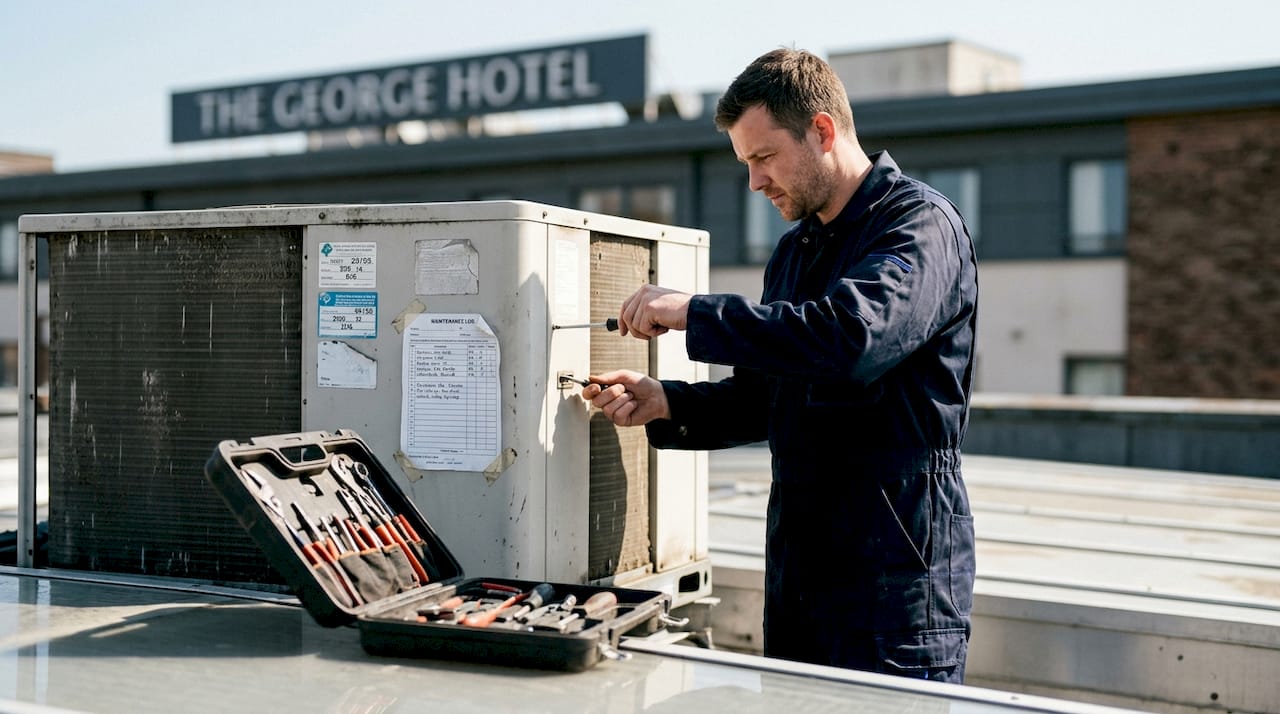
Predictive maintenance reduces downtime by 50%, cuts maintenance costs by 10-30%, and extends equipment lifespan by 5-10 years. For a hospitality or retail business running multiple cooling assets, that translates into a substantial reduction in total lifecycle cost.
To reduce your total lifecycle cost systematically, follow these steps:
- Audit your existing assets to identify which units are consuming disproportionate energy or generating frequent call-outs.
- Prioritise retrofits on the highest-cost, highest-risk equipment first to secure rapid ROI.
- Install monitoring sensors to enable real-time performance tracking and early fault detection.
- Schedule condition-based servicing rather than fixed-interval maintenance to avoid unnecessary spend.
- Review maintenance cost savings data annually to benchmark performance and refine your programme.
Understanding why cooling systems fail is equally valuable. Most failures are preceded by detectable warning signs that predictive systems catch weeks in advance.
Pro Tip: When planning retrofits, prioritise units that are over eight years old and running fixed-speed compressors. These offer the greatest efficiency gap and therefore the fastest payback when upgraded.
Environmental impact, compliance, and future readiness
Beyond cost and comfort, sustainability and regulations now shape business choices, often as much as budgets do. The regulatory landscape for commercial cooling is tightening, and businesses that act early will be better positioned than those that wait.
Key sustainability and compliance considerations include:
- Transitioning to low global warming potential (GWP) refrigerants to meet F-gas phase-down requirements
- Implementing heat recovery systems to repurpose waste heat for hot water or space heating
- Aligning with Scope 1 and Scope 2 emissions targets under corporate sustainability frameworks
- Preparing for stricter energy performance certificate (EPC) requirements for commercial premises
- Leveraging grid decarbonisation to amplify the carbon benefit of efficiency improvements over time
Efficiency improvements have cut demand by 20% in developed countries since 2000, with retail facilities reducing Scope 1 and 2 emissions by 19%. These are not marginal gains; they represent a meaningful shift in the environmental footprint of commercial operations.
From a financial standpoint, energy code adoption returns investment within 2-5 years for hotels and retail premises, with long-term lifecycle savings that far exceed the upfront cost. Understanding refrigeration compliance in 2026 is now a baseline requirement, not an optional extra.
| Sustainability measure | Typical payback | Primary benefit |
|---|---|---|
| Low-GWP refrigerant switch | 2-4 years | Regulatory compliance |
| Heat recovery integration | 3-5 years | Reduced energy spend |
| Full system efficiency upgrade | 2-5 years | Emissions and cost reduction |
Staying ahead of commercial refrigeration trends in 2026 means understanding not just what is available today, but what will be required tomorrow.
Practical limitations and what to watch for
While the benefits are compelling, there are key caveats every efficient cooling project must address. No technology delivers its full potential without the right conditions, installation quality, and operational context.
The main challenges to plan for include:
- Extreme cold weather performance: Heat pumps lose efficiency in cold climates due to defrost cycles, which reduce output and increase energy draw precisely when heating demand is highest.
- Equipment sizing errors: Oversized or undersized units never operate in their optimal efficiency range, undermining the projected savings from day one.
- Advanced refrigerant cost premiums: Low-GWP refrigerants often carry a higher purchase price, which can extend payback periods if not factored into the business case.
- Grid limitations: In locations with unreliable or carbon-intensive grid supply, the environmental benefit of efficiency upgrades is partially offset.
- High upfront capital requirements: Even with strong ROI, the initial investment can be a barrier for businesses with constrained capital budgets.
Pro Tip: Before committing to any upgrade, assess your local climate profile, grid carbon intensity, and capital availability alongside the projected ROI. A project that looks compelling on paper may need phasing or alternative financing if your operational context does not match the standard case study.
Exploring the advantages of commercial refrigeration for your specific business type will help you identify which technologies offer the most realistic return given your constraints.
A new perspective on energy efficient cooling: what really matters in 2026 and beyond
Most conversations about energy efficient cooling focus on hardware. New compressors, smarter controls, better refrigerants. These matter, but in our experience, the businesses that achieve the most significant and lasting results are the ones that approach the problem as a whole-system challenge rather than a product selection exercise.
Passive and hybrid technologies, such as night-time pre-cooling and thermal mass strategies, hold genuine promise but only when matched carefully to local climate conditions. Chasing incentives for a technology that does not suit your building or region is a common and costly mistake.
Perhaps more importantly, grid decarbonisation combined with efficiency measures delivers greater savings than a refrigerant switch alone. As the grid becomes cleaner, the carbon value of every kilowatt-hour you save increases automatically. That means today’s efficiency investment compounds in environmental value over time without any additional action.
Our advice is to go beyond product specifications. Use a 4E analysis, covering energy, exergy, economics, and environment, when evaluating major decisions. It takes more time upfront, but it consistently surfaces the options with the strongest long-term case.
Maximise your energy efficiency with trusted commercial solutions
The evidence is clear: energy efficient cooling delivers measurable savings, improved comfort, lower maintenance costs, and stronger compliance positioning for businesses in hospitality and retail. The question is not whether to act, but how to act strategically.
At EcoFrost, we specialise in commercial AC installation and retrofits tailored to the specific demands of hospitality and retail environments. With over 10 years of experience across the UK, Qatar, and India, we bring the technical depth and commercial understanding to design solutions that genuinely perform. Explore our range of cost-efficient refrigeration options, or contact our team to discuss a bespoke assessment for your site.
Frequently asked questions
How much can UK businesses save with energy efficient cooling?
UK businesses in retail and hospitality typically achieve 20-40% reductions in cooling costs when adopting technologies such as VFDs, EC fans, and smart controls. Actual savings depend on the age of existing equipment and operational hours.
Does upgrading cooling equipment disrupt daily operations?
Modern retrofits are designed for minimal interruption, with phased installation approaches that keep your business running throughout. Predictive maintenance reduces future downtime by 50% compared to legacy reactive servicing, with ROI typically achieved in under three years.
Are energy efficient cooling systems always better for the environment?
They significantly reduce emissions, particularly when paired with low-GWP refrigerants and a decarbonising grid supply. Retail facilities have reduced Scope 1 and 2 emissions by 19%, though benefits depend on correct sizing and quality installation.
What is the typical ROI period for energy efficient cooling retrofits?
Most hospitality and retail projects achieve full ROI within 2-5 years. Energy code-compliant upgrades consistently show payback periods in this range, with long-term lifecycle savings that significantly exceed the initial investment.
Do heat pumps work as efficiently in all climates?
Heat pumps perform best in mild climates. Performance drops in extreme cold due to defrost cycles, which reduce output efficiency and increase energy consumption, making correct equipment selection critical for colder regions.