
TL;DR:
- Smart refrigeration uses sensors and automation for real-time, demand-responsive cooling management.
- Upgrading can reduce energy costs by up to 30 percent and improve operational efficiency.
- It is scalable and suitable for businesses of all sizes, with retrofit options and easy remote monitoring.
Businesses in hospitality and retail lose thousands annually to inefficient refrigeration, yet many operators still rely on ageing systems with no visibility into performance or energy use. Traditional fridges and cold rooms run on fixed cycles, react poorly to demand changes, and offer no early warning when something goes wrong. The result is wasted energy, unexpected breakdowns, and spoiled stock. Smart refrigeration changes all of that. This guide explains what smart refrigeration actually is, how it cuts costs in measurable ways, and how you can adopt it across your hospitality or retail operation with confidence.
Table of Contents
- Defining smart refrigeration: beyond the basics
- How smart refrigeration saves energy and reduces costs
- Smart refrigeration in action: applications for hospitality and retail
- Implementation guide: steps to adopt smart refrigeration
- Why smart refrigeration is the new business essential
- Ready to future-proof your refrigeration?
- Frequently asked questions
Key Takeaways
| Point | Details |
|---|---|
| Smart features defined | Smart refrigeration uses automation, sensors, and remote control to optimise energy use and performance. |
| Cost savings potential | Upgrading can reduce energy costs by up to 30 percent, benefiting your bottom line immediately. |
| Wide range of uses | Hotels, restaurants, and retailers all see safety and efficiency gains from smart refrigeration. |
| Easy adoption | A step-by-step approach makes moving to smart refrigeration simple for businesses of all sizes. |
| Long-term competitive edge | Early adopters of smart technology set themselves apart and prepare for future market changes. |
Defining smart refrigeration: beyond the basics
Smart refrigeration is not simply a newer fridge with a digital display. It is a fully connected system that uses sensors, automation, and data to manage cooling performance in real time. Where a conventional system runs to a fixed schedule regardless of conditions, a smart system adapts continuously, responding to temperature fluctuations, door openings, stock levels, and ambient heat.
The core technologies involved include Internet of Things (IoT) sensors that monitor temperature and humidity at multiple points, automated controls that adjust compressor output based on live data, and cloud-based dashboards that give you remote visibility from any device. Predictive analytics then process this data to flag potential faults before they become failures.
Here is how smart refrigeration compares to conventional systems:
| Feature | Conventional refrigeration | Smart refrigeration |
|---|---|---|
| Temperature monitoring | Manual checks | Continuous, automated sensors |
| Fault detection | After failure occurs | Predictive alerts before failure |
| Energy management | Fixed cycles | Demand-responsive automation |
| Compliance reporting | Manual logs | Automated digital records |
| Remote access | Not available | Full remote monitoring |
| Maintenance scheduling | Time-based | Condition-based |
As commercial refrigeration trends show, smart systems use sensors, automation, and remote monitoring to achieve optimal efficiency at every stage of operation.
Some common misconceptions are worth addressing directly:
- Smart refrigeration is only for large chains. Not true. Scalable solutions now serve single-site retailers and boutique hotels just as effectively.
- It requires a complete system replacement. Many smart upgrades can be retrofitted onto existing equipment.
- The data is too complex to use. Modern dashboards are designed for non-technical users, with clear alerts and simple controls.
- It is more expensive to maintain. Predictive maintenance actually reduces reactive repair costs significantly.
For a broader view of how sustainability and efficiency connect in modern cooling systems, our sustainable refrigeration guide covers the principles in detail. If you are also evaluating specific equipment types, the guide on efficient food storage is a practical companion resource.
How smart refrigeration saves energy and reduces costs
Understanding the technology is key, but the real question is: how does it impact your bottom line? The answer is significant. Energy costs can fall by up to 30 percent when businesses switch from conventional to smart refrigeration. That figure is not theoretical. It reflects real operational changes driven by automation and data.
Traditional systems waste energy in several predictable ways: compressors run at full capacity even during low-demand periods, temperature drift goes unnoticed until product is at risk, and maintenance is reactive rather than planned. Each of these issues carries a direct financial cost.
Here is how smart refrigeration addresses them:
- Demand-responsive compressor control adjusts cooling output based on actual conditions, eliminating unnecessary energy draw during quieter periods.
- Real-time temperature alerts catch deviations immediately, preventing spoilage and the associated stock replacement costs.
- Predictive maintenance scheduling replaces emergency call-outs with planned servicing, reducing repair bills and downtime.
- Automated defrost cycles run only when needed rather than on a fixed timer, saving energy without compromising hygiene.
- Energy reporting dashboards give you clear data to identify inefficiencies and make informed decisions about further improvements.
The financial impact across different business types is substantial:
| Business type | Estimated annual energy saving | Additional operational benefit |
|---|---|---|
| Mid-size restaurant | £2,000 to £4,500 | Reduced spoilage, fewer emergency repairs |
| Retail convenience store | £1,500 to £3,000 | Lower maintenance costs, better compliance |
| Hotel food and beverage | £4,000 to £8,000 | Automated HACCP records, reduced staff time |
| Supermarket or large retailer | £10,000+ | Full energy visibility, demand management |
The latest energy saving refrigeration trends confirm that businesses investing in smart controls are consistently outperforming those still running legacy equipment. For hotels specifically, our guide on hotel refrigeration efficiency outlines how different system configurations affect running costs.
Pro Tip: Connect your smart refrigeration dashboard to your energy billing data. When you can see exactly which units are consuming the most power and at what times, you can make targeted adjustments that compound savings over time.
Smart refrigeration in action: applications for hospitality and retail
With the savings apparent, let us ground this with real examples of smart refrigeration working in business environments you will recognise.
In a busy restaurant kitchen, spoilage is one of the most controllable yet frequently ignored costs. Smart refrigeration systems track the temperature of every unit continuously. If a walk-in chiller drifts above the safe threshold during a busy service, the system sends an immediate alert to a manager’s phone rather than waiting for a morning check. Restaurants and hotels use smart systems to meet food safety standards and streamline inventory, replacing paper-based HACCP logs with automated digital records that are always audit-ready.
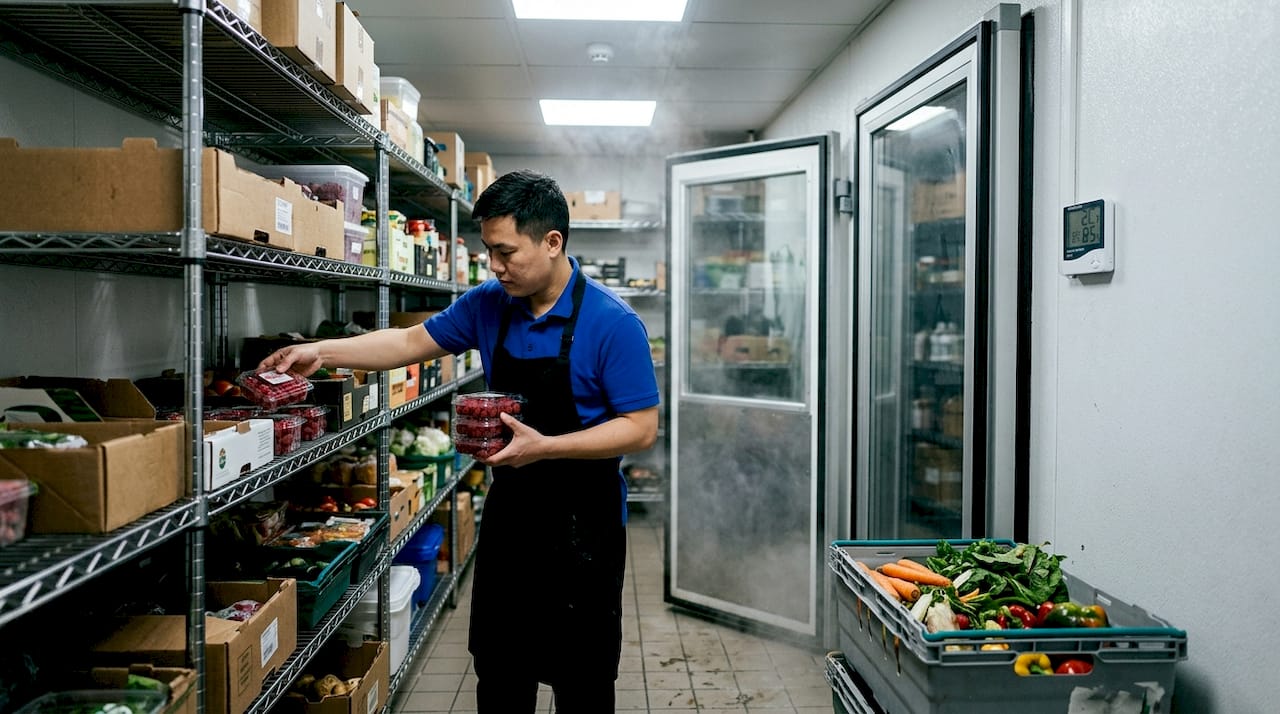
In retail, the benefits extend to merchandising as well as operations. A chilled display unit that loses cooling overnight can result in a full shelf of wasted product by morning. Smart monitoring catches the fault within minutes and alerts staff before stock is compromised.
Key applications across both sectors include:
- Automated compliance reporting for food safety audits, removing the burden of manual temperature logging
- Remote monitoring across multiple sites from a single dashboard, ideal for chain operators
- Inventory integration that links temperature data with stock management systems
- Energy consumption tracking by unit, by zone, and by time of day
- Predictive fault alerts that allow planned maintenance rather than emergency call-outs
- Demand-based cooling that reduces energy use during quieter trading hours
“Smart refrigeration systems are transforming how hospitality and retail businesses manage food safety, turning compliance from a manual burden into an automated, reliable process.”
Pro Tip: When selecting a smart refrigeration solution, prioritise systems with open-protocol connectivity. This means the system can integrate with your existing building management software or energy monitoring tools without requiring a full infrastructure overhaul.
For further context on why refrigeration quality is central to safe food service, our article on refrigeration in restaurants is worth reviewing alongside the full range of restaurant refrigeration solutions available for different kitchen configurations.
Implementation guide: steps to adopt smart refrigeration
Seeing how others succeed paves the way. Here is how to make smart refrigeration a reality in your business, from the first assessment through to ongoing operation.
Selecting commercial refrigeration involves evaluating your business needs, future-proofing your investment, and planning for maintenance from the outset. Follow these steps to approach the process methodically:
- Conduct an energy audit. Before purchasing anything, map your current refrigeration assets, their age, energy ratings, and maintenance history. This reveals where the biggest inefficiencies lie.
- Define your compliance requirements. Identify which food safety standards apply to your operation, such as HACCP in the UK or equivalent frameworks in Qatar and India, so your chosen system can meet them automatically.
- Assess retrofit versus replacement. Newer smart sensors and controllers can often be added to existing units. A qualified engineer can advise on whether retrofitting is cost-effective for your current equipment.
- Choose a scalable platform. Select a system that can grow with your business. A solution that works for one site should be capable of managing five or ten sites from the same dashboard.
- Plan installation carefully. Schedule installation during low-trading periods to minimise disruption. Ensure your team understands the new controls before going live.
- Train your staff. The best system delivers poor results without user understanding. Invest time in training so staff can act on alerts and use the reporting tools effectively.
- Review performance data regularly. Set a monthly review of energy consumption and maintenance records. Use the data to refine settings and identify further savings.
When evaluating specific solutions, look for these features as a minimum:
- IoT-enabled sensors with cloud connectivity
- Real-time alerts via mobile or email
- Automated temperature logging for compliance
- Predictive maintenance notifications
- Energy consumption reporting by unit
- Compatibility with existing building management systems
Professional installation and ongoing maintenance are not optional extras. They are what ensures your investment performs as promised over its full operational life.
Why smart refrigeration is the new business essential
Here is a frank view from our experience working with hospitality and retail operators across the UK, Qatar, and India: the businesses that treat refrigeration as a background utility are consistently the ones facing the largest energy bills and the most disruptive breakdowns.
Conventional wisdom has long held that refrigeration is a fixed cost, something you budget for and largely ignore. That assumption is becoming increasingly expensive to maintain. Energy prices are volatile, food safety regulations are tightening, and customers expect operational consistency that ageing systems simply cannot guarantee.
What we observe is that early adopters of smart refrigeration are not just saving money. They are building a measurable competitive advantage. They spend less time managing reactive problems and more time running their businesses. Their compliance records are clean, their stock losses are lower, and their maintenance costs are predictable.
Waiting for your current system to fail before upgrading is a costly strategy. The businesses that act on refrigeration upgrades and efficiency now will be operating from a position of strength while others are still catching up. The technology is proven, the savings are documented, and the barriers to adoption are lower than most operators realise.
Ready to future-proof your refrigeration?
If you are ready to move beyond reactive maintenance and fixed energy bills, EcoFrost is the partner to make it happen. With over 10 years of experience serving hospitality and retail businesses across the UK, Qatar, and India, we bring practical expertise to every stage of your refrigeration journey.
From commercial fridge and freezer installation to scheduled EcoFrost maintenance services and rapid commercial refrigeration repairs, we cover every aspect of your refrigeration needs. Our team will assess your current setup, recommend the right smart solution for your operation, and support you through installation and beyond. Get in touch with EcoFrost today to start reducing costs and improving performance.
Frequently asked questions
What makes a refrigeration system ‘smart’?
A smart refrigeration system includes digital controls and automation alongside remote monitoring, giving you the ability to track and adjust performance from anywhere for maximum efficiency.
How much can I save by upgrading to smart refrigeration?
You could achieve energy savings of up to 30 percent compared to older systems, with additional reductions in maintenance and stock loss costs over time.
Is smart refrigeration suitable for both small and large businesses?
Yes. Smart solutions scale effectively from small retail shops through to large hotels and multi-site restaurant groups, making them a practical choice regardless of your operation’s size.
Are there any additional maintenance requirements for smart refrigeration?
Predictive analytics simplify maintenance considerably by flagging issues before they escalate, though staff training remains important to ensure alerts are acted upon promptly and correctly.