

TL;DR:
- Improper refrigerant recovery poses significant compliance, environmental, and financial risks in commercial HVAC and refrigeration. Proper recovery involves certified equipment, thorough planning, and record-keeping to ensure legal and efficient handling of refrigerants during servicing or decommissioning. Large-scale operations benefit from advanced methods and proactive management to optimize recovery speed, reduce costs, and maintain regulatory compliance.
Improper refrigerant recovery is one of the most overlooked compliance risks in commercial HVAC and refrigeration. Many business owners assume it only applies when scrapping old equipment, but UK law requires proper recovery during routine servicing, repairs, and leak work too. The consequences of getting it wrong include significant fines, failed audits, and the kind of reputational damage that no business can afford. This guide breaks down exactly what refrigerant recovery involves, what the law expects, and how to handle it efficiently across any size of operation.
Table of Contents
- What is refrigerant recovery and why does it matter?
- Essential equipment and safe recovery practices
- Methods of refrigerant recovery: Vapour, liquid, and push-pull
- What happens after recovery? Recycling, reclamation, and legal requirements
- Efficiency, challenges, and advanced tips: Scaling recovery for large operations
- What most people miss about refrigerant recovery: Quality, planning, and cost
- Get expert help for compliant refrigerant recovery
- Frequently asked questions
Key Takeaways
| Point | Details |
|---|---|
| Compliance is essential | UK law requires proper refrigerant recovery to protect your business from fines and operational risks. |
| Choose the right method | Matching the method to your system saves time and boosts efficiency. |
| Avoid cross-contamination | Use dedicated equipment for each refrigerant type to prevent costly errors. |
| Professional support pays | Expert help with large or complex jobs prevents mistakes and speeds up maintenance. |
What is refrigerant recovery and why does it matter?
Refrigerant recovery means removing refrigerant from a system safely and collecting it in a certified cylinder for reuse, recycling, or controlled disposal. It is not simply a case of venting gas into the atmosphere. In fact, doing so is illegal under UK F-Gas regulations, which exist specifically to limit the release of fluorinated greenhouse gases that cause significant environmental harm.
For UK businesses, refrigeration compliance is not optional. The F-Gas Regulation (EU 517/2014, retained in UK law post-Brexit) places strict requirements on certified engineers, record-keeping, and refrigerant handling. Businesses that fail to use F-Gas certified engineers or that cannot demonstrate proper recovery face financial penalties and potential prosecution.
Several misconceptions continue to cause problems in practice:
- Recovery is only required when decommissioning equipment. False. It is required whenever refrigerant is removed, including during servicing and repair.
- Small top-up jobs do not require documentation. False. Any intervention involving refrigerant requires a log entry.
- Any engineer can carry out recovery work. False. Engineers must hold a valid F-Gas certificate to handle refrigerants legally.
Energy savings and compliance are closely linked, and businesses that take recovery seriously typically manage their refrigerant stock better, reducing the need for costly top-ups and avoiding unnecessary downtime.
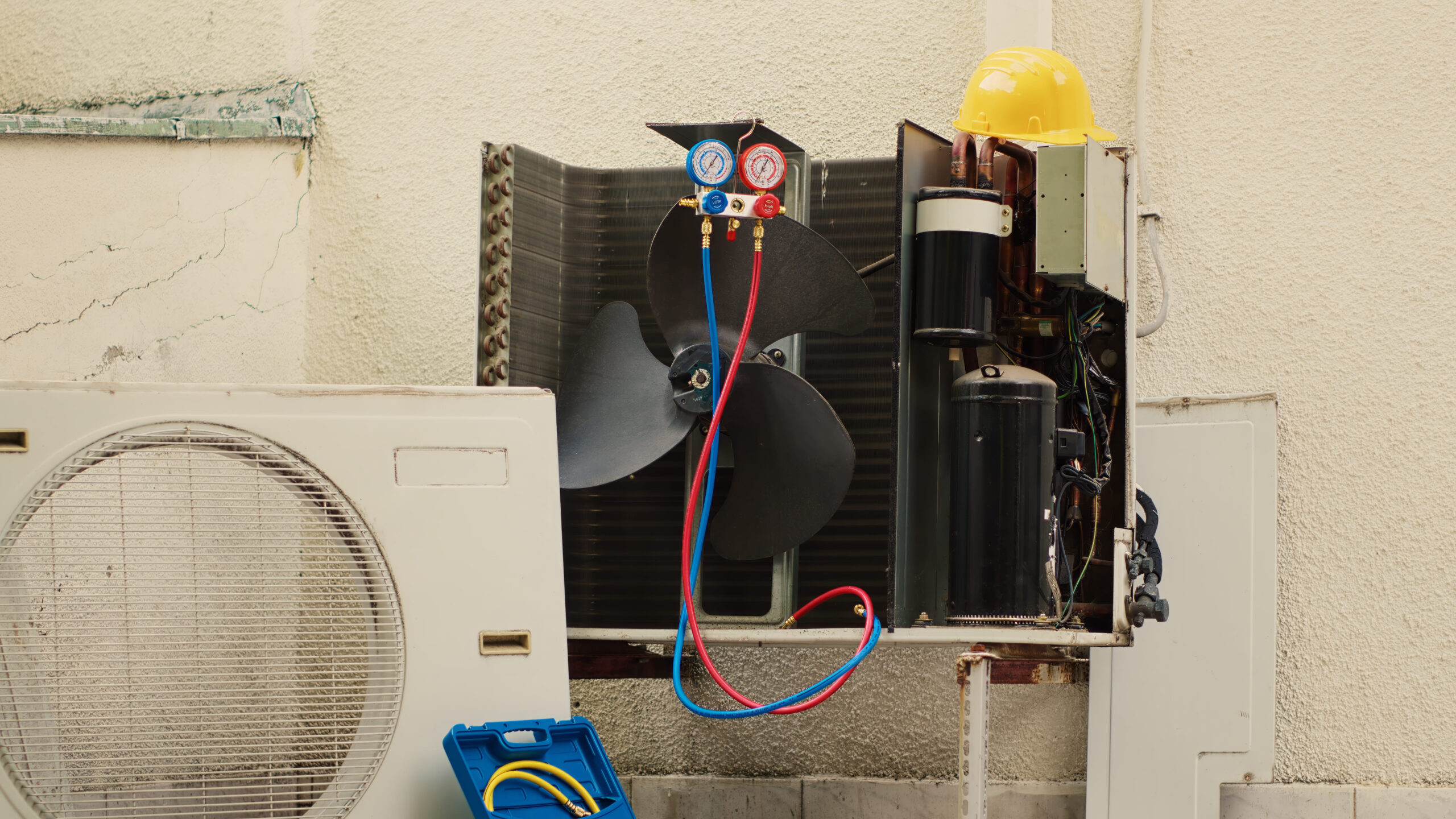
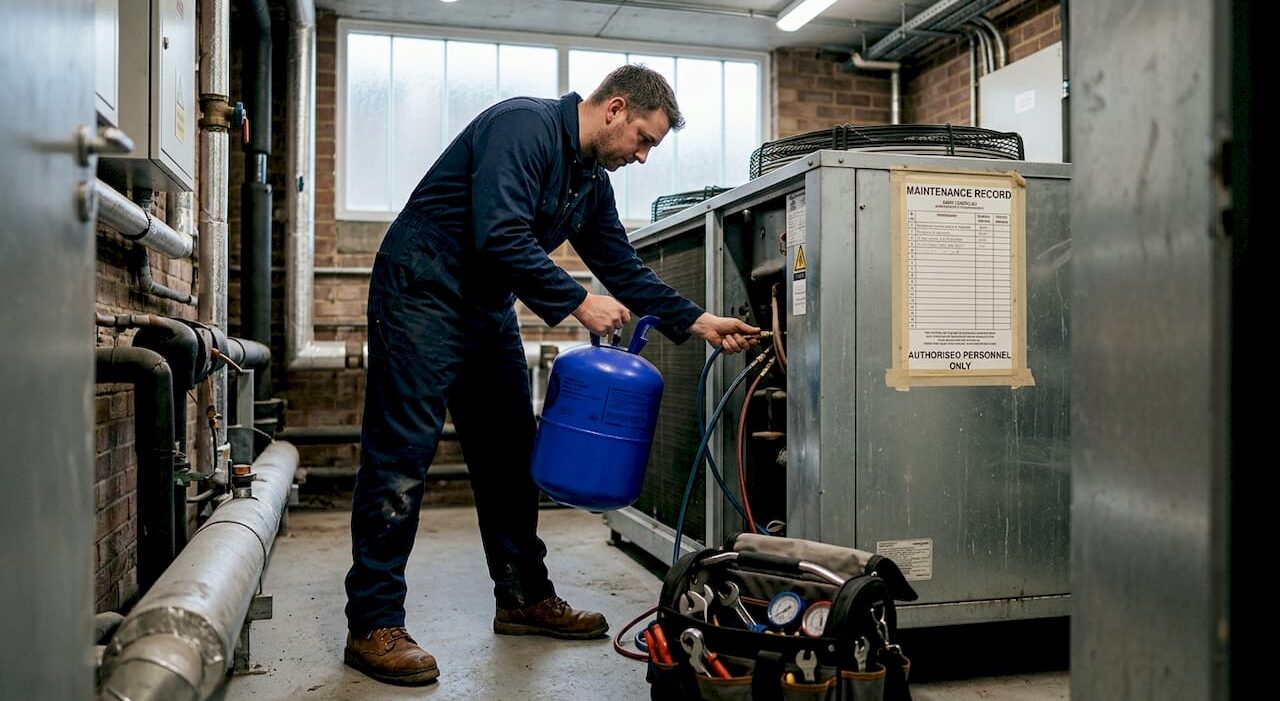
Operationally, recovery is performed with a refrigerant recovery machine connected to the system via service ports, using gauges, a scale, and recovery cylinders to control exactly what is removed and where it goes. This is a precise, controlled process, not a quick disconnect job.
Pro Tip: Build refrigerant recovery time into your planned maintenance schedule. Treating it as an afterthought creates last-minute delays, incomplete records, and compliance gaps that will surface during an audit.
Fines under UK F-Gas legislation can reach thousands of pounds per violation. For multi-site operations, a single systemic failure to document recovery across a portfolio of systems could trigger investigations across every site. The financial exposure is significant, and it is entirely preventable with proper planning.
Essential equipment and safe recovery practices
With an understanding of the compliance landscape, let’s turn to the practicalities: what do you actually need to carry out refrigerant recovery safely and effectively?
The right equipment is not negotiable. Using incorrect or uncertified tools puts engineers at risk, damages refrigerant quality, and can invalidate your compliance records. Here is a standard tool checklist for any recovery job:
| Equipment | Purpose |
|---|---|
| Refrigerant recovery machine | Removes refrigerant from the system under controlled conditions |
| Certified recovery cylinder | Stores removed refrigerant safely at correct pressure |
| Manifold gauge set | Monitors system pressure throughout the process |
| Digital refrigerant scale | Measures the exact weight of refrigerant recovered |
| Service hoses and valves | Connects recovery machine to system service ports |
| Personal protective equipment (PPE) | Protects engineer from refrigerant exposure |
A step-by-step approach to recovery keeps the process safe and documentation accurate:
- Identify the refrigerant type. Check the system data plate and service log. Never assume.
- Prepare a dedicated, correctly labelled recovery cylinder for that specific refrigerant type.
- Connect the recovery machine to the system service ports using suitable hoses. Check all connections for tightness before proceeding.
- Place the recovery cylinder on the digital scale and zero the reading. This allows you to track exactly how much refrigerant is removed.
- Start the recovery machine and monitor both system pressure and cylinder weight throughout.
- Stop recovery when system pressure reaches the correct low-pressure target for the refrigerant type. Do not overfill the cylinder.
- Isolate valves, disconnect hoses, and check for any residual pressure before completing the job.
- Record all details in the equipment log, including refrigerant type, weight recovered, cylinder reference, and engineer certification number.
“Recovery is typically performed with a recovery machine connected to the system via service ports, with gauges, a scale, and recovery cylinders to control what is removed and where it goes.”
Common risks during recovery include refrigerant leaks from loose connections, overfilling cylinders (which creates a serious pressure hazard), and incorrect labelling that leads to contamination problems later. Reviewing your refrigeration setup steps before any recovery work helps identify potential access or pressure issues in advance. Keeping systems clean also improves recovery accuracy; poorly maintained systems can introduce contaminants into the recovery process, so regular cleaning of refrigeration units is directly relevant to recovery quality.
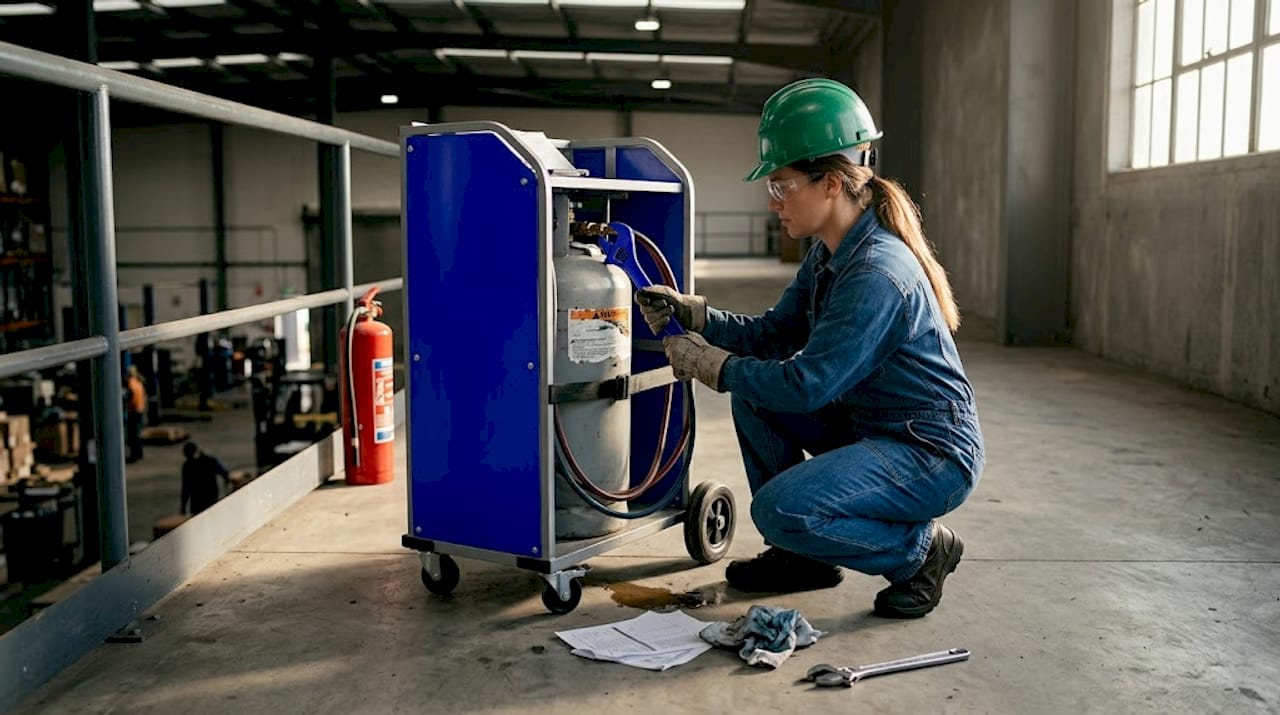
Pro Tip: Always double-check the refrigerant type before beginning recovery. Mixing refrigerants in a single cylinder, even in small amounts, can render the entire contents unusable and create a costly disposal problem.
Methods of refrigerant recovery: Vapour, liquid, and push-pull
Now that the equipment and basic routine are clear, it is time to look at the three standard methods for actually recovering refrigerant, each with unique advantages depending on your system type and the volume involved.
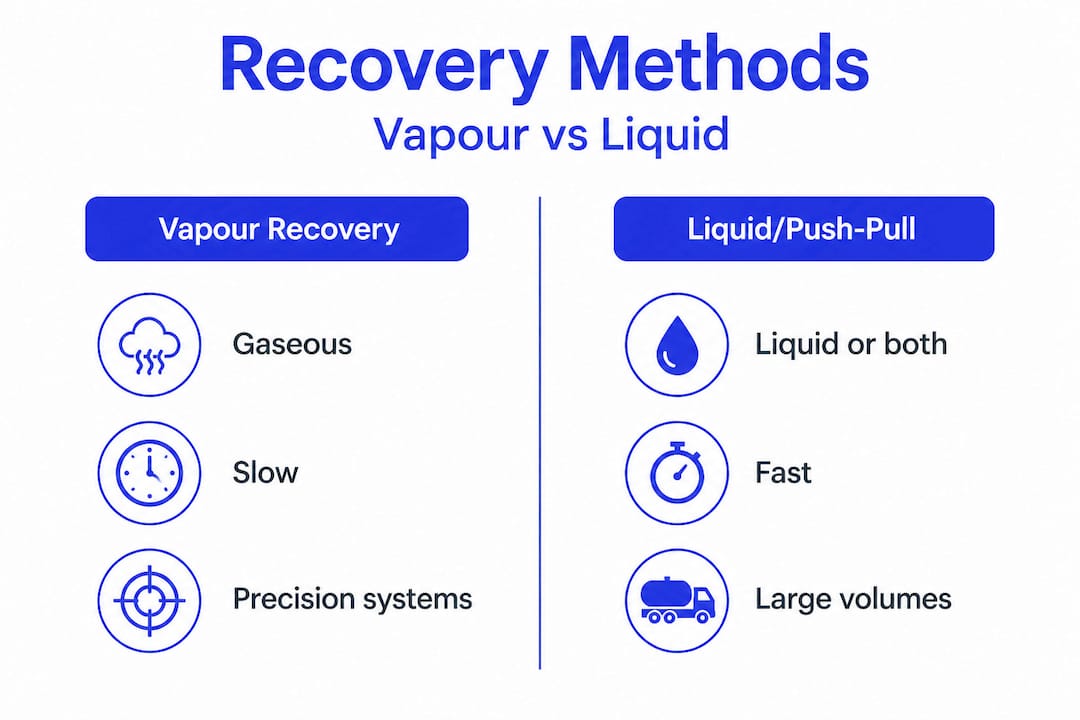
Vapour recovery draws refrigerant from the system in its gaseous state. It is the slowest of the three methods but is well-suited to smaller systems where precision matters more than speed. Because it handles only vapour, there is lower risk of liquid carry-over into the recovery machine, which protects the equipment and keeps the recovered product cleaner.
Liquid recovery removes refrigerant in its liquid phase, which is significantly faster than vapour recovery. It works best on larger systems where bulk removal is needed and where the system configuration allows liquid to be drawn off efficiently. The speed advantage is considerable, though engineers must manage the process carefully to avoid liquid slugging in the recovery machine.
Push-pull recovery combines both approaches. It uses the recovery machine to pull vapour from one side of the system while simultaneously pushing liquid out from the other, typically using the system’s own pressure differential. This method is most efficient for large systems with significant refrigerant volumes, and it substantially reduces recovery time compared to either vapour or liquid recovery alone.
| Method | Speed | Best for | Key consideration |
|---|---|---|---|
| Vapour recovery | Slow | Small systems, precision work | Lower risk of machine damage |
| Liquid recovery | Fast | Medium to large systems | Requires careful flow management |
| Push-pull recovery | Fastest | Large commercial systems | Needs experienced engineer to set up correctly |
For businesses managing multiple large energy-efficient refrigeration assets, push-pull recovery often represents the most practical choice when decommissioning or carrying out major maintenance. Understanding which method suits your system prevents wasted time and reduces the risk of incomplete recovery, which is itself a compliance issue.
What happens after recovery? Recycling, reclamation, and legal requirements
Having covered the major recovery methods, the next step is to understand your obligations and options once the refrigerant has been removed.
Not all recovered refrigerant follows the same path. The distinction between recycling and reclamation is important, and confusing the two can lead to compliance errors.
- Recycling involves basic cleaning of recovered refrigerant, typically through filtering and drying, allowing it to be reused in the same system or in a compatible one. It does not restore the refrigerant to its original specification and is generally performed on-site or at a basic servicing level.
- Reclamation is a more thorough process. A certified, authorised facility reprocesses the refrigerant to a quality comparable to virgin refrigerant, meeting recognised standards such as AHRI 700. Only reclaimed or virgin refrigerant can legally be used to service most systems under current UK F-Gas rules.
This distinction matters financially too. Reclaimed refrigerant is typically cheaper than virgin product, so businesses that invest in proper recovery and send refrigerant for reclamation can reduce their future refrigerant costs. It also supports compliance by demonstrating that recovered material is handled through approved channels.
Key legal points to keep in mind:
- Recovered refrigerant must be stored in correctly labelled, pressure-rated cylinders
- It cannot be mixed with other refrigerant types, even similar ones
- Disposal must go through an approved waste contractor if the refrigerant cannot be reclaimed
- Records of recovery, storage, and disposal must be retained and made available on request
Effective refrigeration maintenance for compliance includes planning for refrigerant handling at every stage of a system’s life. Businesses that treat refrigerant as a manageable asset rather than a disposal problem consistently report lower running costs and fewer compliance issues. Unplanned refrigeration downtime risks often trace back to poor refrigerant management during earlier service visits, underscoring why proper recovery and record-keeping matter even when systems appear to be running well.
Efficiency, challenges, and advanced tips: Scaling recovery for large operations
For businesses with large or multiple systems, efficiency and error prevention become even more critical. Let’s look at what best practice looks like in the real world.
Standard recovery processes can become inadequate when dealing with significant refrigerant volumes across complex systems. A compelling real-world example: a specialist rapid recovery service recovered 450 kg of HFCs from 22 rooftop VRF units in approximately five hours. Conventional recovery methods were described as inefficient for a job of that scale, raising safety concerns due to the time and handling involved. Purpose-built rapid recovery equipment, combined with experienced team coordination, made the difference.
For facility managers overseeing large refrigeration portfolios, the lessons are clear. Here are the best practices for scaling recovery effectively:
- Plan system access before the job starts. Rooftop units and complex plant rooms require safe access routes and sufficient space for recovery equipment. Organise this in advance, not on the day.
- Use dedicated recovery cylinders for each refrigerant type. Label every cylinder clearly with refrigerant type, date, and job reference. Do not share cylinders across different refrigerant types under any circumstances.
- Match recovery method to system size. Push-pull recovery is almost always the right choice for large systems. Using vapour-only recovery on a 200 kg system wastes hours and increases handling risk.
- Coordinate engineer teams for multi-unit jobs. Two or three engineers working simultaneously across a bank of units, each with their own recovery equipment, can reduce overall job time dramatically.
- Document in real time. Do not rely on memory or end-of-day summaries. Record weights, cylinder references, and refrigerant types as each unit is completed.
- Arrange reclamation logistics before the job. Know exactly where cylinders are going after the job. Leaving recovered refrigerant in unlabelled cylinders in a plant room is both a compliance failure and a safety risk.
Pro Tip: For large-scale operations, consider investing in rapid recovery services from a specialist contractor rather than scaling up with standard equipment. The time saving on a multi-unit job often justifies the cost many times over, particularly when cost-efficient refrigeration solutions are part of your operational strategy.
What most people miss about refrigerant recovery: Quality, planning, and cost
With the main approaches and best practices covered, it is worth highlighting the aspects that separate merely legal recovery from strategic, cost-saving operations.
In practice, many businesses treat refrigerant recovery as a compliance obligation and nothing more. The paperwork gets filed, the cylinder gets collected, and that is the end of it. But this approach consistently leads to unnecessary costs and, in many cases, outright compliance failures that only surface later.
The most significant and underestimated issue is refrigerant quality control. Mixing different refrigerants in a single cylinder contaminates both, rendering the contents unusable and often unsuitable for reclamation. What should have been a saleable or reusable asset becomes an expensive disposal problem. This happens more often than most engineers would admit, usually due to time pressure or inadequate labelling systems on busy multi-unit jobs.
The financial impact of contaminated refrigerant is higher than many businesses anticipate. A contaminated cylinder of R-410A or R-32, for example, cannot be sent for reclamation. It must be disposed of by a specialist contractor, and the business pays for disposal rather than recovering any value from the refrigerant. On large systems, this cost can run into hundreds of pounds per incident, and it is entirely avoidable.
Planning recovery by refrigerant type is not optional. It is a fundamental requirement of a competent refrigerant management programme. Businesses that label cylinders clearly, assign them to specific refrigerant types, and audit their stock regularly avoid these problems entirely.
The other gap we see regularly is a lack of pre-job planning. Poor planning drives surprise compliance costs: engineers arriving without the right cylinder type, jobs running long because recovery equipment is undersized, or reclamation being delayed because no collection route was arranged in advance. These are not technical failures. They are organisational ones, and they are far more common than refrigeration failure risks that receive far more attention. Quality and thorough planning are what separate businesses that manage refrigerant well from those that manage it expensively.
Get expert help for compliant refrigerant recovery
Staying on top of refrigerant recovery requirements takes more than good intentions. It takes certified engineers, the right equipment, and a clear process that stands up to regulatory scrutiny.
EcoFrost HVAC supports businesses across the UK with fully compliant refrigerant recovery, from routine servicing callouts to large-scale decommissioning projects. Our F-Gas certified engineers handle recovery, documentation, and reclamation logistics so that your business stays protected. Whether you need support for your cold room solutions, a new fridge and freezer installation, or ongoing compliance management across multiple sites, we bring the same rigorous approach to every job. For businesses navigating HVAC refrigerant compliance, our team provides clear, upfront guidance and fast response when it matters most. Get in touch with EcoFrost HVAC to discuss your requirements.
Frequently asked questions
Do I need to recover refrigerant every time I service my HVAC system?
Yes. UK law requires recovery whenever refrigerant is removed, including during routine servicing or repairs, not only at end of life.
Can I store different refrigerants in one recovery cylinder?
No. Mixing different refrigerants in a single cylinder causes contamination and may render the contents unusable, breaching both quality standards and regulations.
What is the difference between recycling and reclamation of refrigerants?
Recycling is basic cleaning and reuse on-site; reclamation reprocesses refrigerant to near-virgin quality at an authorised facility, meeting recognised performance standards.
How fast is rapid refrigerant recovery for large sites?
With professional equipment and experienced engineers, 450 kg can be recovered from 22 rooftop units in approximately five hours, making rapid recovery far more practical than conventional methods for large operations.
Recommended
- Refrigerants in HVAC: Energy savings and compliance 2026 – Ecofrost hvac Ltd
- What is refrigeration compliance and why it matters in 2026
- Top commercial refrigeration trends for energy savings in 2026
- Why upgrading retail refrigeration boosts efficiency
- How to boost air conditioning energy efficiency at home