




TL;DR:
- Choosing the wrong refrigerant can lead to legal violations, increased safety risks, and system inefficiencies. Proper selection impacts compliance, operational safety, energy costs, and environmental sustainability. Consulting qualified engineers and assessing site-specific requirements are essential for optimal, compliant refrigeration solutions.
Most business owners assume that any compliant refrigerant will do the job. It is a reasonable assumption, but it is wrong, and the consequences can be costly. The refrigerant inside your cold room or commercial refrigeration system is not a background detail. It directly affects energy bills, system lifespan, regulatory compliance, and the safety of your staff and premises. Overlooking standards for refrigerants, especially those marketed as low-GWP options, can leave your business exposed to legal and operational risk that only becomes visible at the worst possible moment.
Table of Contents
- Understanding refrigerants: What you need to know
- Regulatory pressure: Legal and safety risks of the wrong refrigerant
- Efficiency, costs and performance: The business impacts of your refrigerant
- Making the right refrigerant choice for your business
- Why businesses must take refrigerant choice more seriously
- Find the safest, most efficient refrigerant solution for your business
- Frequently asked questions
Key Takeaways
| Point | Details |
|---|---|
| Compliance is essential | Every refrigerant, regardless of type, must meet strict UK safety and environmental regulations. |
| Right choice boosts savings | Selecting a suitable refrigerant improves efficiency, lowers costs, and prevents downtime. |
| Low-GWP isn’t enough | Even eco-friendly refrigerants still require compliance checks and careful handling. |
| Professional advice matters | Expert guidance ensures the correct refrigerant for both your compliance and operational needs. |
Understanding refrigerants: What you need to know
Refrigerants are the working fluids that make cooling possible. They cycle through your refrigeration system, absorbing heat from the storage space and releasing it outside. Without the right refrigerant, the entire system becomes less efficient, more prone to failure, and potentially dangerous.
Not all refrigerants are the same. They vary significantly across several key properties:
- Pressure characteristics: Some refrigerants operate at higher pressures, which places greater demand on pipework, seals, and compressors.
- Flammability: Certain modern refrigerants, including several popular low-GWP options, are mildly or highly flammable. This changes how they must be handled, stored, and installed.
- Global Warming Potential (GWP): GWP is a measure of how much a refrigerant contributes to climate change if released. Lower GWP is increasingly required under UK and EU phase-down rules.
- Cooling performance: Different refrigerants deliver different levels of efficiency under different operating temperatures, which matters greatly depending on whether you run a chiller room, blast freezer, or multi-zone facility.
Common refrigerants used in UK commercial refrigeration today include R404A and R507 (now being phased out due to high GWP), R448A and R449A (popular HFC blends with lower GWP), and natural refrigerants such as R744 (CO2) and R290 (propane), which are increasingly favoured for sustainability reasons.
The types of restaurant refrigeration you operate will directly influence which refrigerant is appropriate for your system, temperature range, and safety requirements.
Important: Standards apply to all refrigerants, regardless of their global warming potential. Choosing a newer, greener refrigerant does not reduce your compliance obligations. It may, in some cases, introduce additional ones.
Understanding the basics puts you in a far better position when specifying new equipment or reviewing an existing system with your refrigeration engineer.
Regulatory pressure: Legal and safety risks of the wrong refrigerant
Now that you understand the basics, it is vital to recognise the legal responsibilities tied to your refrigerant selection. Two key regulatory frameworks govern commercial refrigeration in the UK: the Pressure Equipment (Safety) Regulations, known as PE(S)R, and the Dangerous Substances and Explosive Atmospheres Regulations, known as DSEAR.
DSEAR applies to flammable refrigerants and PE(S)R to systems over 0.5 bar. In practice, this means that most commercial refrigeration systems fall within the scope of PE(S)R, since they operate well above the 0.5 bar threshold. If your system uses a flammable refrigerant, such as R290 or R32, DSEAR compliance becomes an additional obligation requiring a full hazardous area assessment of your site.
Here is a straightforward comparison of the two main regulatory frameworks:
| Regulation | Applies to | Key requirement |
|---|---|---|
| PE(S)R | Pressure systems above 0.5 bar | Equipment must be properly designed, installed, and maintained |
| DSEAR | Flammable substances on site | Hazardous area classification and risk assessment required |
| F-Gas Regulations | High-GWP refrigerants | Certified engineers must handle, install, and maintain systems |
Many businesses focus on F-Gas compliance and overlook the requirements of PE(S)R and DSEAR entirely. That is a significant risk. Failing to comply with these regulations can result in enforcement action, prohibition notices, and in serious cases, prosecution. Beyond the legal penalties, a non-compliant installation is a safety liability.
Refrigeration compliance in 2026 is more demanding than it was even five years ago. Regulations have tightened, and the shift towards lower-GWP refrigerants has introduced new complexity. A refrigerant that appears greener on paper can actually demand more rigorous safety planning on site.
Pro Tip: If you are unsure whether your current system meets PE(S)R and DSEAR requirements, request a formal compliance review from an F-Gas certified engineer before your next planned maintenance visit. Identifying gaps early is far less disruptive than addressing them after an incident or inspection.
The hidden risk here is assumption. Business owners frequently assume that because their previous refrigerant met compliance standards, switching to a newer alternative will be straightforward. It rarely is without proper assessment. Emergency refrigeration compliance situations, where a business faces sudden regulatory scrutiny following a breakdown or leak, are far more common than most realise, and almost always avoidable with the right planning upfront.
Efficiency, costs and performance: The business impacts of your refrigerant
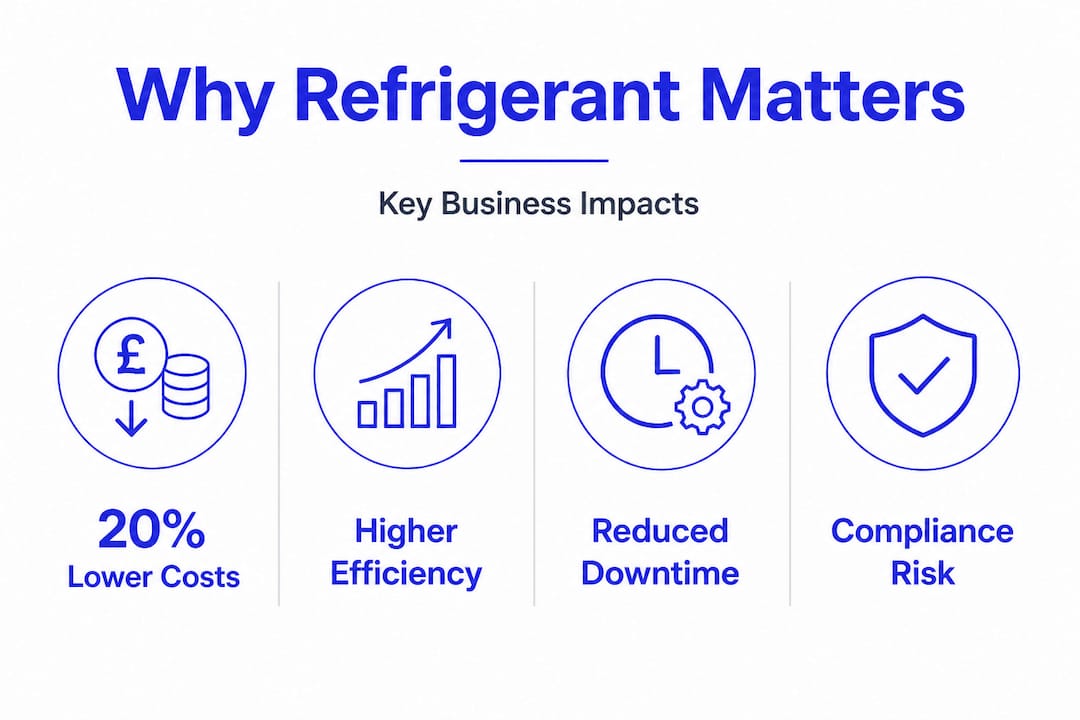
Regulations aside, your bottom line can change dramatically based on the refrigerant in your system. This is where the practical business case for careful refrigerant selection becomes very clear.
Choosing the right refrigerant affects efficiency, maintenance, and sustainability in measurable ways. A refrigerant that is well-matched to your system design and operating temperatures will maintain target temperatures more reliably, consume less energy, and put less stress on key components like compressors and expansion valves.
Here is a practical comparison of commonly used refrigerants in UK commercial refrigeration:
| Refrigerant | GWP | Flammable | Best for | Cost profile |
|---|---|---|---|---|
| R404A | 3922 | No | Medium and low-temp cold stores | High (phase-out costs rising) |
| R448A | 1387 | No | Retrofit replacement for R404A | Moderate |
| R449A | 1282 | No | New medium-temp installations | Moderate |
| R290 (propane) | 3 | Yes | Small commercial units | Low running cost, higher install cost |
| R744 (CO2) | 1 | No | Large facilities, supermarkets | High install cost, very low running cost |
The direct cost consequences of a poor refrigerant choice include higher energy bills, more frequent service callouts, and accelerated component wear. The indirect costs are harder to see but equally damaging: spoiled stock, unplanned downtime, and emergency repairs are all more likely when a system is working harder than it should because of a mismatched refrigerant.

Consider a food manufacturer running a cold store with R404A. As that refrigerant becomes increasingly expensive due to phase-out restrictions, the cost of topping up after a leak becomes significant. Switching to R448A or R449A through a managed retrofit reduces ongoing refrigerant costs and brings the system into better long-term regulatory alignment, while maintaining performance.
Understanding common causes of refrigeration failures reveals that refrigerant mismatches and poor maintenance are among the leading contributors to system breakdowns. Operators who invest in the right refrigerant from the outset, or who manage transitions carefully, consistently see fewer callouts and lower total operating costs over a system’s lifetime.
The environmental dimension also matters to many businesses now, particularly those with sustainability commitments or supply chain requirements from larger customers. The energy-saving refrigeration trends shaping 2026 show a clear industry direction towards natural refrigerants and low-GWP solutions, with better efficiencies achievable when systems are correctly specified from the outset.
There are also genuine commercial advantages of modern refrigeration systems using newer refrigerants, including reduced energy consumption, improved temperature stability, and compatibility with smart monitoring technology.
Making the right refrigerant choice for your business
Finally, let’s apply these insights to help you make the right refrigerant decision for your site. This is not a decision to delegate entirely to a supplier or take lightly at the point of purchase. It requires a structured approach.
Follow these steps when specifying or reviewing your refrigerant:
- Define your operating requirements. What temperature range do you need? A restaurant chiller room and a blast freezer have very different needs, and the right refrigerant for one may be entirely unsuitable for the other.
- Assess your site for safety constraints. Is your plant room well-ventilated? Is it in a public-facing area? Sites with limited ventilation or high occupancy may face restrictions on flammable refrigerants regardless of their efficiency benefits.
- Check current regulatory obligations. Confirm whether PE(S)R and DSEAR apply to your system and what that means for your installation specification. Do not assume compliance carries over automatically from an older system.
- Evaluate total cost of ownership, not just installation cost. Factor in energy consumption, refrigerant price trends, service requirements, and expected system lifespan.
- Consult an F-Gas certified engineer before making any final decisions. A professional assessment of your site, usage patterns, and existing infrastructure will highlight options and risks that are not visible in a product catalogue.
The most common mistakes business owners make in this area include choosing a refrigerant based on price alone, retrofitting a new refrigerant into a system not designed for it, and assuming that a “green” refrigerant automatically means fewer regulatory hurdles. All three errors can be expensive to correct.
Overlooking refrigerant standards can leave your business vulnerable, even when you have made a good-faith effort to choose a low-GWP solution. The standards exist independently of GWP ratings, and compliance requires active engagement, not just good intentions.
Practical guidance on how to select refrigeration for your business can help you understand the broader specification process, while understanding refrigeration for restaurant safety illustrates how refrigerant choice connects directly to food safety and public health obligations in food service settings.
Pro Tip: When planning a new installation or a major system upgrade, always ask your engineer to document the refrigerant selection rationale in writing. This protects you during inspections and gives you a clear record if the system is ever handed to a new maintenance provider.
Why businesses must take refrigerant choice more seriously
Having seen both the risks and the outcomes across a wide range of installations, here is our honest assessment: refrigerant selection is consistently undervalued by business owners, and it is consistently overvalued as a simple technical decision that engineers handle automatically.
The reality is that engineers can only make the best decision within the constraints you set. If you specify the lowest-cost installation, or push for the quickest turnaround, or fail to share the full operational context of your site, the refrigerant choice may be compromised from the start. That is not a failure of engineering. It is a failure of the decision-making process upstream.
We have seen businesses invest in modern refrigeration systems with impressive specifications, only to face repeated service callouts within the first two years because the refrigerant selected did not match the actual workload or ambient conditions of the site. The cost of putting that right, including partial system modifications, additional safety assessments, and lost stock during downtime, far exceeds the cost of a proper specification at the outset.
There is also a competitive dimension that rarely gets discussed. Businesses that manage their refrigerant choices proactively, staying ahead of phase-out timelines and regulatory changes, avoid the panic-driven retrofit costs that their competitors face when deadlines arrive. They also tend to have more energy-efficient systems, which reduces operating costs year on year. Information on refrigerant energy savings and compliance shows how this plays out in practice across different sectors.
The businesses that treat refrigerant selection as a genuine investment decision, rather than a procurement afterthought, are the ones that operate more reliably, spend less on emergency maintenance, and face fewer regulatory surprises. That is the straightforward truth from years of working across UK commercial refrigeration.
Find the safest, most efficient refrigerant solution for your business
Acting on the guidance in this article is a strong start, but translating it into the right specification for your specific site requires professional input. EcoFrost HVAC works with businesses across the UK to deliver refrigeration systems that are compliant, efficient, and built around actual operational needs rather than generic assumptions.

Whether you need a new cold room solution designed from scratch, a fridge and freezer installation that meets current regulations, or expert advice on energy-saving refrigerant options for your next upgrade, our F-Gas certified engineers can guide you through every step. We provide clear recommendations, documented compliance support, and ongoing maintenance cover so your business is always protected. Get in touch with EcoFrost HVAC today to arrange a consultation and find the right refrigerant solution for your operation.
Frequently asked questions
What legal standards affect refrigerant choice in the UK?
PE(S)R and DSEAR are the primary regulations governing pressure and flammability risks in refrigerant systems, alongside F-Gas regulations covering high-GWP refrigerants. All three apply independently of each other and cannot be satisfied by meeting just one.
Does choosing a low-GWP refrigerant exempt my business from compliance?
No. Standards apply to all refrigerants regardless of their GWP rating, and some low-GWP refrigerants actually trigger additional DSEAR obligations due to their flammability classification.
What is the risk of using the wrong refrigerant?
Using the wrong refrigerant can cause legal non-compliance, accelerated system wear, higher energy bills, and potential safety hazards. Overlooking refrigerant standards exposes your business to enforcement action and operational disruption at the same time.
What should I do if my current system uses an outdated refrigerant?
Consult an F-Gas certified engineer to assess your options for retrofit or replacement, ensuring the new specification meets PE(S)R and DSEAR requirements as well as current F-Gas obligations. Acting early gives you more options and avoids forced, costly decisions under deadline pressure.